A closeup shows the fairing of a SpaceX Falcon 9 rocket that was launched from Vandenberg Air Force Base in January 2016. (NASA Photo)
SpaceX has the all-clear to return its Falcon 9 rocket to flight next week after a four-month suspension due to a launch-pad explosion.
The go-ahead came in the form of a launch license issued today by the Federal Aviation Administration for SpaceX’s launch of 10 advanced Iridium Next telecommunication satellites from Vandenberg Air Force Base in California.
Drones were visible in abundance at CES. (FAA Photo)
Drone sightings by commercial pilots are on the rise, and so is the Federal Aviation Administration’s research into systems that detect and defend against unmanned aerial vehicles.
In cooperation with other government agencies and industry partners, the FAA has been testing technologies designed to detect unauthorized drone operations near airports and other critical infrastructure, FAA Administrator Michael Huerta told a packed audience today at the CES show in Las Vegas.
“We’ve evaluated some of these technologies in some pretty complicated places, airports like New York, and Denver, and smaller places like Atlantic City,” he said.
Huerta said further tests will be conducted later this year around Dallas-Fort Worth International Airport.
An artist’s conception shows a permanent lunar base that’s part of the European Space Agency’s “Moon Village” vision. (Credit: ESA)
GUADALAJARA, Mexico – If the world wants to create a village on the moon, the Federal Aviation Administration is willing to start up an online trading post for lunar services.
George Nield, the FAA’s associate administrator for commercial space transportation, says he doesn’t even need to wait for the village to be built.
Nield offered to set up what he called LMASS – the Lunar Marketplace and Swap Shop – during one of today’s sessions at the International Astronautical Congress in Guadalajara.
“Think of it as a corkboard,” Nield said. The potential traders could include businesses that are working on ways to move cargo from low Earth orbit to lunar orbit, or on moon landers, or on habitats, or surface transportation, or communication services, or other technologies that will eventually be needed for lunar operations.
The FAA says it’s a new dawn for commercial drone ventures. (Credit: FAA via Twitter)
More than 3,000 people signed up today to get certified as commercial drone pilots under new regulations, and there’ll be more to come, the head of the Federal Aviation Administration said during a kickoff news briefing in Washington, D.C.
FAA Administrator Michael Huerta said his agency already has issued 76 waivers that allow commercial ventures to go beyond the now-standard rules, FAA Administrator Michael Huerta said. Almost all of those waivers give the go-ahead for flying drones at night, he said. CNN has gotten clearance for flying drones over people, while BNSF Railway will be allowed to fly drones beyond an operator’s visual line of sight.
The FAA’s new regulations for small drones, also known as unmanned aircraft systems or UAS, generally rule out night flying, flights over uninvolved people, or flights beyond the line of sight. But Huerta said the ventures that received waivers have laid out extra measures to ensure safe operation under those conditions.
The new regulations, known as Part 107, were issued in June but didn’t take effect until today. They replace a case-by-case regulatory system for drones weighing less than 55 pounds – a system that relied on individually issued Section 333 exemptions.
A bomb-sniffing dog and its security team from the Transportation Safety Administration keep watch at Washington Dulles International Airport. (Credit: TSA)
The U.S. Senate today gave final congressional approval to a measure that authorizes funding for the Federal Aviation Administration through September 2017 – and also changes procedures for airport security and emergency drone operations.
“It’s a little more than a 14-month extension, but don’t let that fool you, because it is going to put into permanent law bolstering security at our airports in order to help better protect us,” Sen. Bill Nelson, D-Fla., said on the Senate floor.
Bolstering airport security was a high priority for Sen. Maria Cantwell, D-Wash., one of the bill’s sponsors. She said the measure would help head off soft-target airport attacks like the ones that hit Brussels and Istanbul earlier this year.
“By passing this bill, we’re doubling the number of terrorist deterrent teams at U.S. airports and ground transportation hubs,” Cantwell said.
An artist’s conception shows Moon Express’ MX-1 lander extending its robotic arm to take a “selfie” of the spacecraft on the lunar surface with Earth in the background. (Credit: Moon Express)
After months of discussion, federal agencies are closing in on a process to approve commercial missions to other celestial bodies – including the moon, Mars and asteroids.
The groundwork for the process was laid in April, when the White House Office of Science and Technology Policy told Congress that the Transportation Department was the most appropriate entity to approve new kinds of commercial space missions such as on-orbit satellite servicing and trips beyond Earth orbit.
Now the Federal Aviation Administration and other agencies are “working through the interagency process to ensure a mechanism is in place that permits emerging commercial space operations,” FAA spokesman Hank Price said in a statement emailed to GeekWire.
The issue was brought to a head when Moon Express, one of the companies chasing the Google Lunar X Prize, asked the FAA to review its plans to put a lander on the moon next year. The FAA is part of the Transportation Department. Its Office of Commercial Space Transportation is currently in charge of approving commercial space launches and re-entries, but not activities in orbit or in deep space.
An artist’s conce[t shows the Moon Express MX-1 lander orbiting the moon. (Credit: Moon Express)Moon Express, the lunar exploration venture backed by Seattle tech entrepreneur Naveen Jain, says it’s asking the Federal Aviation Administration to conduct a payload review of its spacecraft and plans for a mission to the moon in 2017.
The request is aimed at heading off regulatory uncertainty about the mission, which is aimed at winning the Google Lunar X Prize.
Moon Express ranks among the front-runners in the $30 million competition, which calls for teams to send landers to the moon, travel along the surface and send back real-time video by the end of next year.
Such a feat would represent a first for commercial space ventures, but because it’s unprecedented, it’s not fully clear what kind of regulatory go-ahead would be required for a U.S.-based company. So far, only governmental space programs have sent probes beyond Earth orbit.
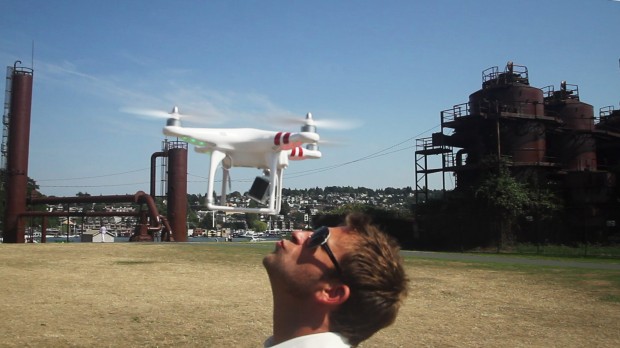
Photographer Chase Jarvis with a drone at Gas Works Park in Seattle.
Drones should face the equivalent of crash-test dummies to gauge how safe they are for flying around people, a panel appointed by the Federal Aviation Administration said in a report released today.
The recommendations from the Micro UAS Aviation Rulemaking Committee laid out a wide range of conditions for letting drones, also known as unmanned aircraft systems, fly close to the uninvolved public. Such flights are not allowed under a different set of regulations that are due for release within the next few months.
The committee, which includes industry representatives and other stakeholders, finished its report in less than a month. “We commend the committee members for their sincere dedication and for producing a comprehensive report in such a short time,” FAA Administrator Michael Huerta said in a statement.
Flirtey’s hexacopter hovers over Nevada during a drone delivery test. (Credit: Flirtey)
A startup named Flirtey says it’s executed the first FAA-approved urban drone delivery in the United States, in a test that could blaze a trail for Amazon and other companies that want to do the same thing.
The GPS-guided drop-off to an unoccupied house took place on March 10 in Hawthorne, Nev. The package of supplies, including bottled water, emergency food supply and a first-aid kit, was lowered by a rope to the house’s front porch from a hovering hexacopter. A drone pilot and several visual observers were on standby in case something went wrong, but they weren’t needed, the company said.
“Conducting the first drone delivery in an urban setting is a major achievement, taking us closer to the day that drones make regular deliveries to your front doorstep,” Flirtey CEO Matt Sweeny said today in a news release about the test.
Flirtey has already used drones to deliver textbooks in Australia and auto parts inNew Zealand, but its grand plan is to crack the market in the United States. That’s why it’s been participating in limited tests sanctioned by the Federal Aviation Administration at specified sites. Last July, Flirtey conducted a similar test for rural drone delivery in Virginia.
Photographer Chase Jarvis with a drone at Gas Works Park in Seattle.
What are the rules for letting a drone get in your face? Right now, there are no rules, but today the Federal Aviation Administration said it’s setting up a committee to come up with a proposal.
The announcement marks the latest step in the FAA’s effort to get a handle on the rapidly rising fleets of small drones, also known as unmanned aircraft systems or UAS.
A year ago, regulators issued draft rules for the operation of commercial drones, like the ones Amazon is working on for package deliveries. Last December, the FAA set up a system for registering recreational drones. Now the FAA and industry representatives will be taking on one of the thornier questions relating to drones: How close can they get to the folks who aren’t operating them?
The newly announced aviation rulemaking committee is due to begin its work in March, and issue its final report to the FAA on April 1.