Categories
GeekWire

Why go to the moon? Playing the Trump card

Bigelow lunar depot
An artist’s conception shows Bigelow Aerospace’s lunar depot in orbit. (Bigelow Aerospace)

Nearly 55 years ago, President John F. Kennedy said America chose to go to the moon and take on other challenges “not because they are easy, but because they are hard.” Now it’s commercial space ventures that are choosing to go to the moon.

Back in the 1960s, the moon effort was aimed at demonstrating America’s greatness. A similar motivation is at work this time around: to demonstrate that President Donald Trump is making America great again.

Trump has given nods to the space effort in his two big speeches: In his inauguration address, he said America was “ready to unlock the mysteries of space.” And in his address to this week’s joint session of Congress, he said seeing American footprints on distant worlds was “not too big a dream.”

So far, however, specifics have been in short supply – no doubt because Trump has other priorities on his mind right now, and because a new administrator for NASA hasn’t yet been named.

That has left commercial players such as Blue Origin, SpaceX and Bigelow Aerospace free to fill in the gaps, adapting their goals in space to fit a first-term time frame.
Get the full story on GeekWire.

Categories
GeekWire

Blue Origin proposes moon delivery in 2020

Image: Jeff Bezos and Blue Origin
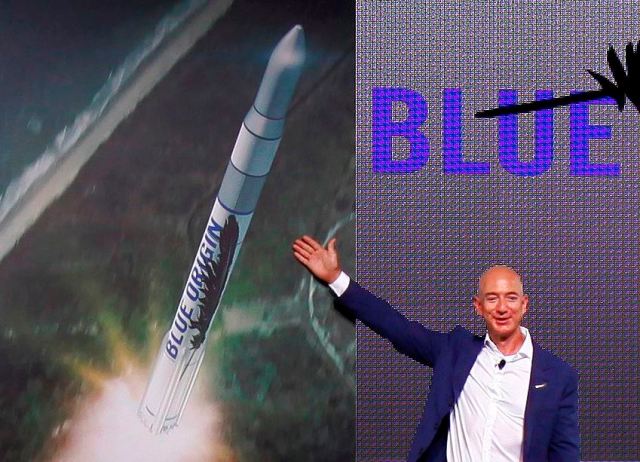
Jeff Bezos shows off the concept for Blue Origin’s launch system during a 2015 news conference in Florida. The rocket could reportedly be adapted for moon missions. (Blue Origin photo)

Amazon billionaire Jeff Bezos’ Blue Origin space venture has reportedly proposed sending a robotic lander to the moon’s south polar region by 2020, as an initial step toward an “Amazon-like” lunar delivery system and eventually a permanently inhabited moon base.

Blue Origin’s white paper is described in a report from The Washington Post, which is owned by Bezos.

The Post says the company’s seven-page proposal, dated Jan. 4, has been circulating among NASA’s leadership and President Donald Trump’s transition team. It’s only one of several proposals aimed at turning the focus of exploration beyond Earth orbit to the moon and its environs during Trump’s term.

Get the full story on GeekWire.

Categories
GeekWire

SpaceX reveals plan for round-the-moon trip

SpaceX Crew Dragon
An artist’s conception shows SpaceX’s Crew Dragon capsule. (Credit: SpaceX)

SpaceX says it’s making plans to send two private citizens around the moon late next year – using its yet-to-be-flown Falcon Heavy rocket and its crew-capable Dragon capsule, which is still under development.

The would-be fliers have not been identified, but they have already paid a “significant deposit” for the trip, SpaceX said today in its announcement of the mission.

The Falcon Heavy would lift off from SpaceX’s launch pad at NASA’s Kennedy Space Center and put the Dragon spacecraft on a free-return trajectory that would loop far beyond the moon and then come back to Earth without any attempt at a lunar landing.

Get the full story on GeekWire.

Categories
GeekWire

NASA looks into quicker trip beyond the moon

Image: Orion
An artist’s conception shows NASA’s Orion capsule in flight. (Credit: NASA)

NASA and its commercial partners say they’re studying the possibility of sending astronauts beyond the moon years earlier than planned, by putting a crew on the first flight of the space agency’s heavy-lift Space Launch System.

The NASA study, sparked in part by a desire for the Trump administration to do something dramatic in space during its first term, would consider whether such a flight could occur in 2019 or 2020.

The current plan calls for an uncrewed test flight of the SLS and NASA’s Orion capsule in late 2018, known as Exploration Mission-1 or EM-1. That mission would followed by a crewed test flight called EM-2 in the 2021-2023 time frame.

In a statement, NASA said acting administrator Robert Lightfoot asked Bill Gerstenmaier, the agency’s associate administrator for human exploration and operations, to assess whether the first crew could ride on EM-1 instead of EM-2.

Get the full story on GeekWire.

Categories
GeekWire

How to spot a lunar eclipse and that comet

A penumbral lunar eclipse not quite as deep as the one we’re about to see occurred over the Far East in November 2012. (Hong Kong Space Museum Photo via Sky & Telescope)

Tonight’s the night when a lunar eclipse dims the full moon, and when a recently discovered green comet comes closest to our planet. But unless you know what’s coming, you’re almost certain to miss them.

You may miss them anyway, depending on the sky conditions. The forecast for the Seattle area calls for partly cloudy skies with a 20 percent chance of rain.

Get the full story on GeekWire.

Categories
GeekWire

Five teams cleared for X Prize moon race

Image: Lunar lander
An artist’s conception shows Team SpaceIL’s lunar lander. (Credit: SpaceIL)

The organizers of the Google Lunar X Prize competition confirmed that five teams have been cleared to go after the $20 million grand prize, and doled out a total of $1 million to all 16 teams that entered.

These five teams previously reported that they had launch contracts for missions to the moon, and that those deals had received the XPRIZE seal of approval.

Get the full story on GeekWire.

Categories
GeekWire

Last man on the moon leaves a dying wish

Gene Cernan
Apollo 17 commander Gene Cernan wears a spacesuit smeared with lunar dirt in 1972. (NASA Photo)

Apollo 17 commander Gene Cernan, the last human to leave footprints on the moon, passed away today – but his family says his dying wish remains to be fulfilled.

“Even at the age of 82, Gene was passionate about sharing his desire to see the continued human exploration of space, and encouraged our nation’s leaders and young people to not let him remain the last man to walk on the moon,” the family said in a statement released by NASA.

The family statement said Cernan had been suffering from ongoing health issues. He died at a Houston hospital, surrounded by relatives.

Get the full story on GeekWire.

Categories
GeekWire

Moon Express’ moonshot is ‘go with funding’

Moon Express lander
An artist’s conception shows Moon Express’ lander extending its robotic arm to take a “selfie” of the spacecraft on the lunar surface with Earth in the background. (Credit: Moon Express)

An executive at Moon Express has been widely quoted as saying his company has reached its funding goal for this year’s planned commercial mission to the lunar surface, thanks to $20 million in new investment.

“We now have all the resources in place to shoot for the moon,” the Florida-based company’s CEO, Bob Richards, said in a statement. “Our goal is to expand Earth’s social and economic sphere to the moon, our largely unexplored eighth continent, and enable a new era of low-cost lunar exploration and development for students, scientists, space agencies and commercial interests.”

Space News quoted Richards as saying that the latest round of investment includes contributions from new and existing investors, including the company’s chairman and co-founder, Seattle-area tech entrepreneur Naveen Jain.

Get the full story on GeekWire.

Categories
GeekWire

How China plans to put rover on moon’s far side

China's lunar rover
An artist’s conception shows the Chang’e 4 spacecraft landing on the moon. (CCTV via YouTube)

China’s latest white paper on space exploration confirms the country’s plans to send a rover to the moon’s far side in 2018 and put a rover on Mars in 2020.

Today’s white paper, released by the State Council Information Office, says the Chang’e 4 mission will “conduct in-situ and roving detection and relay communications at Earth-moon L2 point” in 2018, the official China Daily newspaper reported.

In 2012, NASA’s Grail probes crash-landed on the moon’s far side – the so-called “dark side” that never faces Earth. However, no spacecraft has made a soft landing on the moon’s normally hidden half.

Communicating with such a spacecraft would require using a relay satellite, such as the one that China plans to send to the L2 gravitational balance point beyond the moon for Chang’e 4.

Get the full story on GeekWire.

Categories
GeekWire

XPRIZE clears Japanese mission to the moon

Team Hakuto rovers
Japan’s Team Hakuto is testing two small rovers known as Tetris (left foreground) and Moonraker (right background). The rovers would ride along with Team Indus’ spacecraft. (Team Hakuto Photo)

The rocketeers on Japan’s Team Hakuto say they’ve gotten the Google Lunar XPRIZE’s seal of approval on its plans for a mission to the moon.

The XPRIZE verification of Team Hakuto’s launch agreement with India’s Team Indus boosts the number of approved competitors to five. That includes Team Indus as well as Moon Express, Synergy Moon and SpaceIL.

“The Google Lunar XPRIZE has always pushed us beyond our limits” Takeshi Hakamada, Team Hakuto’s leader, said in today’s news release. “We will continue to challenge ourselves next year and choose an optimal path to reach the moon.”

Team Hakuto is run by a Tokyo-based startup called ispace, and draws upon expertise from faculty and students at Tohoku University.

Get the full story on GeekWire.