Categories
GeekWire

SpaceX launches from historic moon pad

SpaceX launch
SpaceX’s Falcon 9 rocket rises from Launch Complex 39A. (NASA via YouTube)

SpaceX sent a rocket rising from NASA’s historic Launch Complex 39A today for the first time since the space shuttle fleet retired, marking a new chapter for a pad that served as the springboard for Apollo moon missions.

The Falcon 9 rocket sent a robotic Dragon capsule toward the International Space Station with almost 5,500 pounds of supplies and experiments, under the terms of SpaceX’s multimillion-dollar contract with NASA.

As a bonus, the rocket’s first-stage booster flew itself back to a perfect touchdown at SpaceX’s Landing Zone 1, not far from the Kennedy Space Center launch site in Florida. That’s part of SpaceX’s plan for reusing hardware and driving down the cost of space launches even further.

Get the full story on GeekWire.

Categories
GeekWire

SpaceX delays its first liftoff from historic pad

Falcon 9 rocket
SpaceX’s Falcon 9 sits on Kennedy Space Center’s Launch Pad 39A. (NASA via YouTube)

SpaceX postponed the first launch from NASA’s Kennedy Space Center since the last shuttle flight in 2011, due to concerns about a control system on the Falcon 9 rocket’s second stage.

The Falcon 9 had been due to loft a robotic Dragon cargo capsule into orbit from the center’s Launch Pad 39A in Florida, delivering 5,500 pounds worth of supplies and experiments for the International Space Station.

But with less than 20 seconds left in today’s countdown, SpaceX’s mission managers decided they needed more time to work through a nagging technical issue with the controls for the second stage’s rocket engine nozzle..

Get the full story on GeekWire.

Categories
GeekWire

Museum gets an intact moon rocket engine

F-1 engine
An Apollo-era F-1 rocket engine arrives on a flatbed truck. (Museum of Flight Photo)

When historic rocket engine parts from the Apollo moon missions go on display in May in Seattle, museumgoers will be able to compare them with an intact F-1 engine.

The 50-year-old, 18.5-foot-tall engine arrived at one of the Museum of Flight’s offsite facilities today after a road trip from NASA’s Marshall Space Flight Center in Alabama.

Just to be safe, museum spokesman Ted Huetter declined to say exactly where the rocket engine is being kept while it’s being prepared for display. “I think we’ll leave it as an ‘undisclosed location,’” he told GeekWire.

The intricately machined hardware will complement a set of beat-up components from the first-stage engines that powered Saturn V rockets spaceward during the Apollo 12 and Apollo 16 missions in 1969 and 1972, respectively.

Get the full story on GeekWire.

Categories
GeekWire

Artifacts on display 50 years after Apollo 1 fire

Apollo 1 exhibit
Kennedy Space Center’s “Ad Astra Per Aspera” exhibit honors Apollo 1 astronauts Gus Grissom, Ed White and Roger Chaffee, who died in a launch pad fire in 1967. (NASA Photo / Kim Shiflett)

Fifty years ago today, three NASA astronauts died in a launch pad fire when they couldn’t open the hatch of their Apollo command module to escape. Remains of that module have been held in storage for decades, but never put on display. Until now.

To mark the 50th anniversary of the Apollo 1 tragedy, the Kennedy Space Center Visitor Complex opened an exhibit titled “Ad Astra Per Aspera: A Rough Road Leads to the Stars,” featuring the scorched hatch and other artifacts from the mission that never lifted off.

“I think it’s about time that we paid tribute to the crew with a memorial here at the Kennedy Space Center,” center director Bob Cabana, a former shuttle astronaut, said today during the exhibit’s opening ceremonies.

Astronauts Gus Grissom, Ed White and Roger Chaffee were killed during the pre-launch test on Jan. 27, 1967, after a spark from an electrical short ignited flammable materials inside the capsule where they were sitting.

Get the full story on GeekWire.

Categories
GeekWire

Last man on the moon leaves a dying wish

Gene Cernan
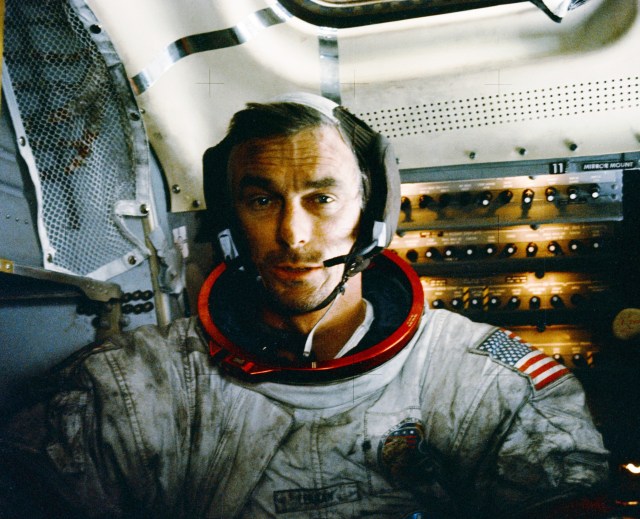
Apollo 17 commander Gene Cernan wears a spacesuit smeared with lunar dirt in 1972. (NASA Photo)

Apollo 17 commander Gene Cernan, the last human to leave footprints on the moon, passed away today – but his family says his dying wish remains to be fulfilled.

“Even at the age of 82, Gene was passionate about sharing his desire to see the continued human exploration of space, and encouraged our nation’s leaders and young people to not let him remain the last man to walk on the moon,” the family said in a statement released by NASA.

The family statement said Cernan had been suffering from ongoing health issues. He died at a Houston hospital, surrounded by relatives.

Get the full story on GeekWire.

Categories
GeekWire

Buzz Aldrin on his health scare and John Glenn

Apollo 11 moonwalker Buzz Aldrin check out the engines on a Saturn V rocket at Kennedy Space Center in Florida. “I’m feeling better and my rocket is ready to launch,” he tweeted. (Buzz Aldrin Photo via Twitter)

Apollo 11 moonwalker Buzz Aldrin made light of what some might consider a close brush with death during an interview that aired today on NBC’s “Today” show – but he made a serious point as well.

A medical emergency at the South Pole forced Aldrin’s evacuation from the South Pole during a tourism trek on Nov. 30. “I got out of breath,” the 86-year-old told interviewer Al Roker at Kennedy Space Center in Florida. “You know, that’s nothing new, except it’s a little more concentrated.”

Aldrin suffered from respiratory problems associated with Antarctica’s cold temperatures and high altitude. “Not much air to breathe up there,” he said. He was airlifted to a hospital in Christchurch, New Zealand, for a week of recuperation.

It didn’t sound as if he had any regrets.

“When turning back is about as difficult as pressing on, you press on, because you’ve got an objective,” Aldrin said. “Especially when they tell me that I just set a record – the oldest guy to the South Pole. See, now it was worth it, really!”

Get the full story on GeekWire.

Categories
GeekWire

Flags fly at half-staff in tribute to John Glenn

Flag at Capitol
A flag flies at half-staff at the U.S. Capitol in Washington, D.C. (House of Representatives Photo)

American flags around the world will be flying at half-staff for the next few days in memory of John Glenn, the pioneering astronaut and long-serving senator who died Dec. 8 at the age of 95.

The traditional order was given today in a proclamation from President Barack Obama. The half-staff order applies until sunset on the day of Glenn’s interment, the timing of which has not yet been announced.

Glenn made history in 1962 as the first NASA astronaut to circle the planet – as a follow-up to Soviet cosmonaut Yuri Gagarin’s orbital feat a year earlier, plus two U.S. suborbital spaceflights.

That’s not his only claim to fame. In 1957, as a Marine Corps aviator, Glenn broke the transcontinental flight speed record (which has been broken several times since then). In 1974, he became the first spaceflier to get elected to the U.S. Senate. And in 1998, he became the oldest human in space when he flew on the shuttle Discovery at the age of 77.

As news spread of his death in a hospital in Columbus, Ohio, accolades flooded in from all over the world. We’ve already passed along a lot of Twitter tributes, but here are a few more…

Get the full story on GeekWire.

Categories
GeekWire

John Glenn’s parting words to Jeff Bezos

Image: Jeff Bezos and Blue Origin
Jeff Bezos shows off the concept for Blue Origin’s launch system during a 2015 news conference in Florida. Bezos’ Blue Origin space venture is headquartered in Kent, Wash. (Blue Origin photo)

Amazon billionaire Jeff Bezos accepted yet another award tonight for his Blue Originspace effort, but the prize he treasured the most is no doubt an accompanying letter from space hero John Glenn, who passed away 10 days after writing it.

The letter, dated Nov. 28, was made public as Bezos received a Smithsonian American Ingenuity Award tonight in Washington, D.C. The first African-American woman to fly in space, Mae Jemison, read Glenn’s tribute to Bezos at the ceremony – only hours after Glenn died in an Ohio hospital.

Blue Origin has successfully sent its New Shepard suborbital rocket ship to outer space and back five times, duplicating Mercury astronaut Alan Shepard’s ride. And it’s gearing up to build New Glenn rockets that will send spacecraft into orbit, just as Glenn went into orbit in 1962.

Glenn wrote that he was “deeply touched” to have a rocket named after him.

Get the full story on GeekWire.

Categories
GeekWire

John Glenn, first American in orbit, dies at 95

John Glenn
John Glenn orbited the planet in 1962 and flew on the space shuttle in 1998. (NASA Photo)

Godspeed, John Glenn.

The first American to go into orbit, and the first astronaut to become a senator and presidential candidate, died today in Ohio at the age of 95.

The Columbus Dispatch reported that Glenn was surrounded by family, including his wife Annie, at the Ohio State University Wexner Medical Center when he died.

President Barack Obama said that with Glenn’s passing, “our nation has lost an icon, and Michelle and I have lost a friend.”

“John always had the right stuff, inspiring generations of scientists, engineers and astronauts who will take us to Mars and beyond — not just to visit, but to stay,” Obama said in a statement.

Glenn made history as one of NASA’s original Mercury 7 on Feb. 20, 1962, when he circled the planet three times. That mission followed up on Soviet astronaut Yuri Gagarin’s first-ever orbital flight in 1961 and two U.S. suborbital spaceflights, setting the stage for America to get into the race to the moon in earnest.

Get the full story on GeekWire.

Categories
GeekWire

Get a video tour of Apollo moon rocket artifacts

It’s been almost a year since Amazon billionaire Jeff Bezos unveiled pieces of the Saturn V rocket engines that propelled Apollo’s astronauts to the moon – and now you can watch a video guide to the goodies, courtesy of Seattle’s Museum of Flight (and GeekWire).

Next spring, the decades-old artifacts will be among the highlights of a remodeled exhibit focusing on the golden age of spaceflight, which reached its climax with the Apollo moon missions.

But for now, they’re sitting in one of the museum’s secure storage areas, ready to be installed once the exhibit space is ready.

After each Saturn V launch, the rocket’s first stage – including its 19-foot-tall F-1 engines – fell into the Atlantic Ocean while the rest of the spacecraft powered onward. If anyone had been there to see the first stage’s plunge, it wouldn’t have been a pretty sight.

“When hot engines hit cold seawater, often the engines just exploded,” said Geoff Nunn, the Museum of Flight’s adjunct curator for space history (and your guide for the video tour).

Get the full story on GeekWire.