Stratolaunch’s plane sits at California’s Mojave Air and Space Port. (Stratolaunch Photo)
Stratolaunch, the launch venture created by Microsoft co-founder Paul Allen, took the world’s biggest airplane out of its hangar this weekend at California’s Mojave Air and Space Port and revved up its engines in preparation for the next step toward shooting rockets into space from midair.
The rocket-launching part is still a year or two away, but Stratolaunch is aiming to put the 385-foot-wide, twin-fuselage plane through its first test flight within the next couple of months.
Stratolaunch’s twin-fuselage plane catches the sun’s rays during a test outing. (Stratolaunch Photo)
COLORADO SPRINGS, Colo. — Microsoft co-founder Paul Allen’s Stratolaunch space company says it’s on track to conduct the first test flight of its mammoth airplane this summer, and use it to send rockets into orbit as early as 2020.
The status check came today during a background briefing here at the 34th Space Symposium, conducted under background-only conditions that precluded quoting sources by name.
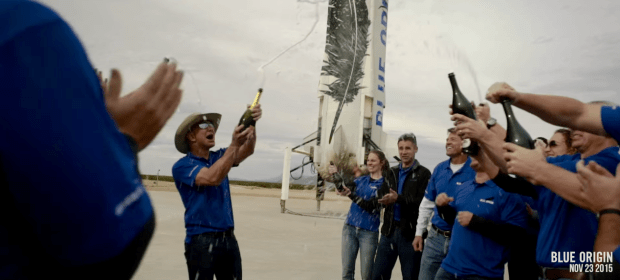
Jeff Bezos, the founder of Amazon and Blue Origin, sprays champagne from a bottle after a successful rocket landing in November 2015. (Credit: Blue Origin via YouTube)
Space is hard: That used to be the excuse for explaining why sending people into space would always be something only governments could do. Now it explains why even billionaires find the feat difficult.
To persevere, even billionaires have to have a passion for spaceflight, most likely fostered at an early age, and an iron resolve to weather adversity. That comes through loud and clear in two newly published books, plus a TV documentary that’s premiering tonight.
An aerial view shows the Stratolaunch airplane outside its hangar in May 2017. The twin-fuselage aircraft is the world’s largest airplane, measured by wingspan. (Stratolaunch Photo)
Microsoft co-founder Paul Allen’s Stratolaunch space venture is returning to an idea it’s long mulled over: launching payloads, and possibly people, into orbit on a reusable space plane.
“I would love to see us have a full reusable system and have weekly, if not more often, airport-style, repeatable operations going,” Allen told Davenport during a Seattle interview.
In a statement emailed to GeekWire, Stratolaunch confirmed its interest in the concept.
“Our vision for Stratolaunch is to offer a broad spectrum of capabilities from small, medium, to fully reusable,” the company said. “Black Ice is an aspirational concept we are exploring; however, no decisions have been made yet.”
Stratolaunch’s twin-fuselage airplane undergoes taxi tests at California’s Mojave Air and Space Port. Note the size of the pickup truck that’s traling the plane. (Stratolaunch Photo)
The six-engine, 385-foot-wide aircraft, nicknamed Roc, is the world’s largest airplane as measured by wingspan. It’s designed to carry up rockets for high-altitude launches in midflight.
Stratolaunch has said orbital launches could begin in the 2019-2020 time frame if the test program goes well.
The world’s biggest airplane taxis along the Mojave Air and Space Port’s runway during a ground test conducted by Stratolaunch. For a size comparison, note the pickup truck driving between the plane’s twin fuselages. (Paul Allen via Twitter)
That’s one more not-so-small step for Stratolaunch’s giant airplane: The space venture’s founder, software billionaire Paul Allen, is showing off a 34-second video of the twin-fuselage aircraft as it aced its first taxi test on the runway at the Mojave Air and Space Port in California.
Allen said the test was conducted Dec. 16, marking a rare outing for the plane that’s destined to serve as a flying platform for launching rockets into space. In a Dec. 17 tweet, he promised that there’d be “more to share soon.”
The Stratolaunch plane has three engines on each wing. (Stratolaunch Photo / Dylan Schwartz)
The world’s biggest airplane hit another milestone this week with the completion of the first phase of engine testing at California’s Mojave Air and Space Port, according to Stratolaunch, the space venture backed by Microsoft co-founder Paul Allen.
Stratolaunch’s CEO, Jean Floyd, reported today that all six of the plane’s Pratt & Whitney turbofan engines were started up for the first time.
“Our aircraft is one step closer to providing convenient, reliable and routine access to low Earth orbit,” Floyd said in a news release.
Air Force Secretary Heather Wilson chats with Stratolaunch CEO Jean Floyd (left) at the company’s hangar in Mojave, Calif. The twin-tailed airplane is behind them. (Heather Wilson via Twitter)
Stratolaunch, the six-year-old space venture backed by Microsoft co-founder Paul Allen, says it’ll use the world’s biggest airplane to launch small satellites into orbit – but what kind of satellites?
An aerial view shows the Stratolaunch airplane outside its hangar for the first time. The twin-fuselage aircraft is the world’s largest airplane, measured by wingspan. (Stratolaunch Photo)
Six years after Microsoft co-founder Paul Allen started up Stratolaunch Systems, the billionaire’s air-launch venture brought its humongous twin-fuselage airplane out in the open for the first time today.
“Stratolaunch came out of the hangar for fuel testing,” Allen said in a tweet that featured an aerial photo of the plane. More pictures were posted to Stratolaunch’s website.
Stratolaunch CEO Jean Floyd said the plane’s emergence from its hangar at California’s Mojave Air and Space Port was part of a “major milestone in its journey toward providing convenient, reliable and routine access to low Earth orbit.”
The plane is designed to carry up to three Orbital ATK Pegasus XL rockets at a time into the air, and then set them loose to launch payloads into orbit.
An artist’s conception shows the Stratolaunch plane. (Stratolaunch Illustration)
Microsoft co-founder Paul Allen’s space venture is rebranding itself and updating its website as it prepares to begin flight tests of the world’s biggest airplane. The venture was launched in 2011 as Stratolaunch Systems, but over time it morphed into Vulcan Aerospace, with Stratolaunch Systems as a subsidiary. Now it’s officially known as Stratolaunch, period. The venture’s website has been changed to reflect the new branding.