Categories
GeekWire

‘The Expanse’ sticks to space realities … mostly

Scene from 'The Expanse'
Spaceship pilot Alex Kamal (played by Cas Anvar) turns a zero-gravity somersault in a scene from “The Expanse.” (Alcon / Syfy via YouTube)

LOS ANGELES — The sci-fi saga known as “The Expanse” has attracted a huge fan following in part because it gets the details of life in space so right, from how to handle zero gravity to what happens when you open up your helmet visor in a hard vacuum.

But there’s one space reality that the producers have thrown out the air lock.

In space, no one can hear your spaceship scream, because there’s no medium to transmit the sound waves. But in “The Expanse,” as in “Star Wars” and other space operas, spaceships whoosh, crash and roar with regularity.

“We actually tried with Season 1 to do it realistically, to not have the ships make a sound,” showrunner Naren Shankar said last week in Los Angeles at the National Space Society’s International Space Development Conference.

Get the full story on GeekWire.

Categories
GeekWire

Report: Amazon talks about reviving ‘The Expanse’

Frankie Adams on "The Expanse"
Frankie Adams plays a Martian Marine in “The Expanse.” (Syfy / Alcon TV Group Photo)

Just days after the Syfy channel announced it was canceling “The Expanse,” sparking a fan campaign to save the space opera, The Hollywood Reporter says Amazon Studios is in talks to keep the show going into a fourth season.

Variety and Deadline said they confirmed the report with their sources. But all three news outlets quoted sources as saying a deal had not yet been closed, and Amazon Studios said the reports were still speculative.

“We are have not confirmed anything about ‘The Expanse’ yet,” Tammy Golihew, director of publicity for Amazon Studios, told GeekWire in an email.

Get the full text on GeekWire.

Categories
GeekWire

‘One Strange Rock’ shows the benefits of bat poop

What do giant fruit bats have in common with Johnny Appleseed? Tonight’s episode of “One Strange Rock,” National Geographic Channel’s documentary series about the interconnectedness of Earth’s ecosystems, provides an answer that’ll awe the grossologist in your family.

During each rainy season, between October and December, up to 10 million of the bats — also known as flying foxes — converge on Zambia’s Kasanka National Park from all over Africa.

“It’s the largest mammal migration on Earth,” conservationist Frank Willems says in National Geographic’s video clip, available via GeekWire as an exclusive preview for tonight’s show. “They fly out in every direction, covering an area of 10,000 square miles.”

The bats gorge themselves on the waterberries, mangoes, musuku fruit and red milkwood berries hanging from the park’s trees, eating enough to equal half of their body weight each night.

As the bats fly back and forth, the fruit and the seeds pass through their digestive system — and yes, National Geographic shows that part of the process, using what appears to be an internal gut-cam. Then the seeds come out the other end and drop to the forest floor.

“The seeds might end up in a completely different place where a new tree can then grow,” Willems says. “We are looking at literally billions of seeds flying all over the continent.”

Get the full story on GeekWire.

Categories
GeekWire

Space billionaires take the spotlight

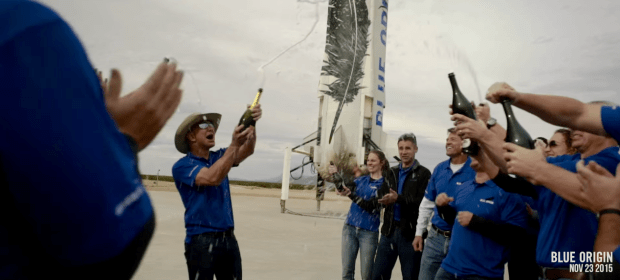
Image: Jeff Bezos and champagne
Jeff Bezos, the founder of Amazon and Blue Origin, sprays champagne from a bottle after a successful rocket landing in November 2015. (Credit: Blue Origin via YouTube)

Space is hard: That used to be the excuse for explaining why sending people into space would always be something only governments could do. Now it explains why even billionaires find the feat difficult.

As SpaceX CEO Elon Musk told me back in 2010, even before he was officially recognized as a billionaire, rocket science is “super-frickin’ damn hard.”

To persevere, even billionaires have to have a passion for spaceflight, most likely fostered at an early age, and an iron resolve to weather adversity. That comes through loud and clear in two newly published books, plus a TV documentary that’s premiering tonight.

Get the full story on GeekWire.

Categories
GeekWire

Even after death, Stephen Hawking stirs up a fuss

Stephen Hawking
Physicist Stephen Hawking visited the Large Hadron Collider’s underground tunnel in 2013. (CERN Photo / Laurent Egli)

The ashes of the late British physicist Stephen Hawking will get a fitting resting place in Westminster Abbey, near the graves of Isaac Newton and Charles Darwin.

But you could argue that the true monuments to Hawking’s memory are his books and theoretical papers, delving into the nature of black holes, the big bang and other cosmic mysteries. And as was often the case during his life, the last paper he completed is stirring up a fuss just days after his death.

Hawking’s so-called “Final Theory” is a paper written with Belgian collaborator Thomas Hertog, and titled “A Smooth Exit from Eternal Inflation?” It hasn’t yet been published in a journal, but it’s said to be under review and is available for inspection on the ArXiv pre-print server.

The paper focuses on hypotheses having to do with cosmic inflation and the idea that our own cosmos is just one of many universes in a multiverse.

Get the full story on GeekWire.

Categories
GeekWire

TV show reveals turmoil behind solar-powered flight

Solar Impulse pilots and plane
Bertrand Piccard and Andre Borschberg shared the piloting duties on the single-seat Solar Impulse 2 airplane. (Niels Ackermann Photo / Rezo / Solar Impulse)

From the outside, it looked as if the Swiss-led Solar Impulse project smoothly soldiered through adversity as its solar-powered plane made a record-setting trip around the world in 2015 and 2016.

But the perspective was different when seen from the inside: The multimillion-dollar campaign nearly came crashing down when teammates debated whether to go ahead with a crucial Pacific crossing, even though the monitoring system for the autopilot wasn’t working right.

“The engineers were crying,” said Bertrand Piccard, the Swiss psychiatrist and adventurer who served as Solar Impulse’s co-founder, chairman and one of its pilots. “They were begging me to stop.”

The turmoil as well as the technology behind the globe-girdling, fuel-free odyssey are on full display in “The Impossible Flight,” a two-hour NOVA documentary premiering on PBS tonight.

Get the full story on GeekWire.

Categories
GeekWire

Spoof touts Quentin Tarantino’s R-rated ‘Star Trek’

What would an R-rated “Star Trek” movie directed by Quentin Tarantino look like?

We may find out someday soon: The director of “Kill Bill,” “Pulp Fiction,” “Inglorious Basterds” and other violence-laced neo-noir films is reportedly working with “Revenant” screenwriter Mark L. Smith and producer J.J. Abrams on a harder-edged version of the Starship Enterprise’s saga.

Nerdist has already put together a must-see video trailer for a Tarantino-tinged Trek, titled “Quentin Tarantino’s Star Trek: Voyage to Vengeance.”

Get the full story on GeekWire.

Categories
GeekWire

‘Saturday Night Live’ spoofs Amazon’s HQ2 quest

Kyle Mooney as Jeff Bezos
Kyle Mooney plays Amazon founder Jeff Bezos on “Saturday Night Live.” (NBC via YouTube)

By Alan Boyle and Todd Bishop

Amazon’s HQ2 search made it all the way to “Saturday Night Live” tonight, with a skit that depicts Jeff Bezos receiving delegates from cities in the company’s top 20 — assisted by Alexa, of course.

So who did NBC’s comedy writers pick as the final four for the Seattle-based online retailing giant’s second headquarters, with 50,000 high-paying jobs and $5 billion at stake?

Get the full story on GeekWire.

Categories
GeekWire

‘Cosmos’ returns to TV in 2019 with new twists

Ship of the Imagination on 'Cosmos'
The Ship of the Imagination is getting ready to set sail again in “Cosmos: Possible Worlds,” due to air on Fox and National Geographic in the spring of 2019. (Fox via YouTube)

Like hope, “Cosmos” springs eternal.

That’s the message Ann Druyan is delivering with the news that “Cosmos,” the science-minded TV show pioneered by her late husband, world-renowned physicist Carl Sagan, is returning to Fox and National Geographic in the spring of 2019.

“I would love for this show to be a kind of initiation experience for as many people around the world as possible, into the awesome power of science as a way to keep us from lying to each other, and lying to ourselves,” she told reporters today during a teleconference.

Get the full story on GeekWire.

Categories
GeekWire

Gravitational waves play role in black hole show

Black hole
A disk of superheated debris blazes around a black hole. The bright circular pattern is caused by the gravitational lensing of light from the part of the disk that’s behind the black hole. (NOVA via YouTube)

Black holes are the collapsed stars of the show on “Black Hole Apocalypse,” a two-hour “NOVA” presentation that’s premiering Jan. 10 on PBS. But the Laser Interferometer Gravitational-Wave Observatory, also known as LIGO, gets its share of the spotlight as well.

“LIGO both opens and closes the show,” said Barnard College astrophysicist Janna Levin, who wrote a book about the gravitational-wave quest and hosts the “NOVA” program. “It’s the most important thing going on right now for black hole astrophysics.”

Get the full story on GeekWire.