Categories
GeekWire

Stoplight tips workmates to leave you alone

FlowLight at work
A green light means it’s OK to chat with a FlowLight user. (UBC Photo)

It’s a classic conundrum for coders: Sometimes you get so absorbed in what you’re doing that you hate being interrupted, and you can’t even stop to put up a “Do Not Disturb” sign.

That’s where FlowLight could come in handy.

The gadget, invented by a computer scientist at the University of British Columbia, monitors your keystrokes and mouse clicks to determine how deeply you’re engaged in your work. When the activity hits a pre-set level, the light on the device turns from green to red.

“The light is like displaying your Skype status – it tells your colleagues whether you’re busy or open for a chat,” Thomas Fritz, an assistant professor at UBC who started work on the invention at the University of Zurich, explained in a news release.

Get the full story on GeekWire.

Categories
GeekWire

Bezos’ $941M stock sale fuels Blue Origin

Jeff Bezos
Jeff Bezos discusses Blue Origin’s New Shepard booster rocket and crew capsule at the Space Symposium (GeekWire Photo / Kevin Lisota)

Billionaire Jeff Bezos’ Blue Origin space venture is sure to benefit from his record-high $941 million selloff of Amazon shares. The sale, executed this week and reported in a filing with the Securities and Exchange Commission, represents just a thin slice of the Amazon founder’s estimated $80 billion net worth. But it meshes with his comment last month at a Colorado space conference that he sells “about a billion dollars a year of Amazon stock, and I use it to invest in Blue Origin.”

Get the news brief on GeekWire.

Categories
GeekWire

Hubble spies galaxies far, far away

Abell 370
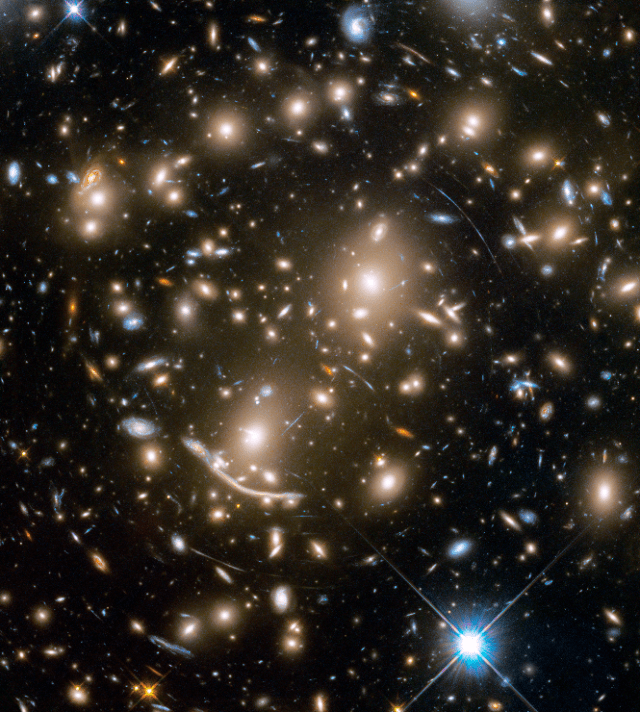
A Hubble Space Telescope view shows the Abell 370 galaxy cluster. (NASA / ESA / HST Frontier Fields)

Choose your movie meme: “Guardians of the Galaxy Vol. 2,” or “Star Wars” for May the Fourth. Either way, the Hubble Space Telescope’s newly released picture of the Abell 370 galaxy cluster is just the ticket.

This composite view from Hubble’s Wide Field Camera 3 and the Advanced Camera for Surveys shows hundreds of galaxies in the cluster, which is 6 billion light-years away in the constellation Cetus.

The view is remarkable not only because the galaxies are so dense, but also because their mass serves as a gravitational lens, focusing the light from even more distant galaxies into luminous arcs of blue light.

Get the full story on GeekWire.

Categories
GeekWire

OneRadio unveils wideband radio receiver

OneRadio display
OneRadio shows the “fingerprints” of radio signals across a wide swath of bandwidth. (OneRadio Image)

OneRadio Corp. has been working on its dragnet for radio transmissions for two years in stealth mode, but the spinout from the University of Washington’s CoMotion innovation program is finally ready to go public.

The startup plans to demonstrate its wideband radio receiver platform next week at the 2017 IEEE Radar Conference in Seattle.

“This is a great coming-out party for us,” OneRadio CEO Mohan Vaghul told GeekWire.

Get the full story on GeekWire.


Categories
GeekWire

SpaceX updates plan for internet satellites

SpaceX Falcon 9 launch
SpaceX plans to launch its own satellites on Falcon 9 rockets, like the one shown here lifting off from NASA’s Launch Complex 39A in Florida. (SpaceX Photo)

SpaceX has laid out its latest schedule for the satellite broadband service it’s developing in the Seattle area, starting with the launch of a prototype satellite by the end of this year.

The ambitious plan foresees beginning the launch of operational satellites into low Earth orbit aboard Falcon 9 rockets in 2019, with the constellation reaching its full complement of 4,425 satellites by 2024.

That constellation would provide high-speed internet access to billions of people around the globe, beaming data via the Ku and Ka transmission bands to SpaceX’s laptop-sized user terminals. Another 7,500 satellites operating in the V-band could be added later to boost the network’s capabilities.

This week’s update came in testimony provided to the Senate Commerce Committee by Patricia Cooper, SpaceX’s vice president for satellite government affairs.

Get the full story on GeekWire.

Categories
GeekWire

Stephen Hawking: Leave Earth in 100 years

Stephen Hawking
British physicist Stephen Hawking looks into technologies that could help humanity create a second home beyond Earth within the next century. (Credit: Discovery Channel)

In an upcoming TV documentary, British physicist Stephen Hawking revives his prediction that humanity will have to spread out a new home in space within 100 years in order to ensure the species’ survival.

But this time, he’s looking into how it can be done.

The two-part documentary, titled “Expedition New Earth,” is due to air on BBC Two as part of the British network’s revived “Tomorrow’s World” TV series.

Hawking has repeatedly warned of the potential threats facing humanity, including nuclear war, rapid climate change, potential pandemics, catastrophic asteroid strikes and even a robot uprising. That echoes similar warnings issued by Elon Musk, the billionaire founder of SpaceX.


Get the full story on GeekWire.

Categories
GeekWire

Listen to the sound of silence in Saturn orbit

Saturn and rings
The hexagon-shaped cloud system at Saturn’s north polar region looms in the foreground with the planet’s rings stretching across the background, in an image captured by the Cassini spacecraft’s camera on April 26. Click on the image for a larger version. (NASA / JPL-Caltech / Kevin M. Gill Image / CC-BY-2.0)

The researchers behind NASA’s Cassini mission to Saturn are relieved, and a bit mystified, to discover that the narrow gap between the giant planet and its rings is virtually devoid of stray particles.

The discovery comes from the bus-sized Cassini spacecraft’s first dive through the gap on April 26, which marked the beginning of the end for the 20-year mission.

“The region between the rings and Saturn is ‘The Big Empty,’ apparently,” Cassini project manager Earl Maize of NASA’s Jet Propulsion Laboratory said in a news release.

Get the full story on GeekWire.

Categories
GeekWire

Amazon patent points to Alexa phone plan

Alexa phone application
A diagram shows how an Alexa-powered device could link up with a user’s mobile phone. (Amazon Illustration via USPTO)

We’ve known for weeks that Amazon has been working on ways to give Alexa-powered, voice-controlled devices the ability to make and receive phone calls, but a newly published patent details how it could be done.

The patent also shows that the idea has been in the works for more than four years.

The system described in the patent would link an existing cellphone number with the Alexa device, and includes a provision for identifying authorized users by their voices. Alexa could let the user know a call is coming in, and then pick it up and route the call over its speaker when the user gives the go-ahead. Users could also initiate calls via Alexa.

Call charges would be billed through the user’s cell carrier, but once the call is routed through the Alexa device, the cellphone would be left out of the picture. Instead, the Alexa device would send the call to the carrier through a type of connection known as voice over Internet Protocol, or VOIP.

Get the full story on GeekWire.

Categories
GeekWire

New SpaceShipTwo flexes its wings in flight

SpaceShipTwo flight
Long-range imagery shows the SpaceShipTwo plane known as VSS Unity with its wings in the feathered position for braking. (MarsScientific.com / Trumbull Studios via Virgin Galactic)

Virgin Galactic passed another essential milestone today in the flight test program for VSS Unity, its upgraded SpaceShipTwo rocket plane, by bending its wings into a “feathered” position for the first time in the air.

The company hailed the gliding test as a success in a series of tweets. Test pilots Mark Stucky and Mike Masucci were at VSS Unity’s controls, while Nicola Pecile and CJ Sturckow piloted the White Knight Two carrier airplane. Flight test engineer Dustin Mosher rode in the mothership as well.

Get the full story on GeekWire.

Categories
GeekWire

Dozens hurt when 777 jet hits rough air

Aeroflot passenger cabin
Aeroflot passengers were hit by clear air turbulence. (Photo via YouTube)

More than two dozen passengers on an Aeroflot Boeing 777 jet reportedly sought medical treatment after a scary run-in with sudden air turbulence during a flight from Moscow to Bangkok, documented on smartphone videos. Citing reports from Thailand, Russian-based Aeroflot said 27 people suffered injuries, including broken bones. However, reports of spinal fractures were unconfirmed.

Get the news brief on GeekWire.