Boeing test pilot Steve “Bull” Schmidt points out features in the cockpit of a prototype T-X training jet to Dennis Muilenburg, Boeing’s CEO, president and chairman, (Boeing Photo)
One of the things I learned about Boeing CEO Dennis Muilenburg is that he loves to fly the aircraft his company makes, even when they’re high-performance military jets.
Take the next-generation T-X training jets, for instance: Last week, Boeing won a $9.2 billion contract to provide hundreds of the planes, plus simulators and services, to the Air Force. The first deliveries aren’t due until 2023, but Muilenburg has already been in the cockpit of a T-X prototype — even though he’s an engineer and a manager, not a pilot.
GeekWire’s Alan Boyle listens to Boeing CEO Dennis Muilenburg during a fireside chat at the GeekWire Summit in Seattle. (Photo by Dan DeLong for GeekWire)
A decade from now, Boeing will still be primarily known as an airplane company, the company’s CEO says. But some of the things we’ll call airplanes might be what we’d call rocket ships today. And whatever you call them, Boeing will make them.
That’s the vision laid out today at the GeekWire Summit by Dennis Muilenburg, Boeing’s CEO, president and chairman. Rather than seeing a sharp division between the world of atmospheric flight and the world of rocket launches, Muilenburg sees a continuum that stretches from personal-sized air taxis to traditional aircraft to hypersonic transports to a whole family of Boeing-built commercial spacecraft.
“Within a decade, you’re going to see low-Earth-orbit space travel become much more commonplace,” he told me. “Not only going to the International Space Station, as we will today, but also other destinations in space. Space tourism, space factories … that whole ecosystem is evolving, and we’ll be deeply involved in the transportation system that will enable access.”
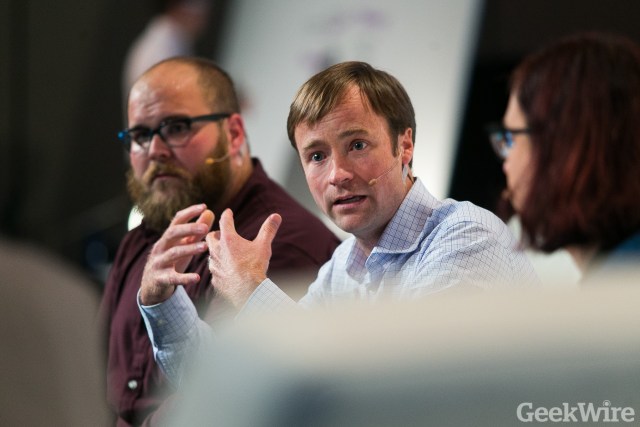
Moderator Mark Harris of The Economist leads a discussion about IoT security with Finite State CEO Matt Wyckhouse, U.S. Rep. Suzan DelBene and University of Washington computer scientist Franziska Roesner at the GeekWire Summit. (GeekWire Photo / Kevin Lisota)
U.S. Rep. Suzan DelBene, D-Wash., says it’s because the IoT market is moving so quickly that what seems secure today may not be so tomorrow.
“There was a time when we had something more static, you could say that it’s got this particular validator on the box, and you knew that it would potentially be good for years to come,” DelBene, who co-founded the Congressional Caucus on the Internet of Things in 2015, said today at the GeekWire Summit. “How do we make sure that if something’s there, it’s really going to mean something months or years down the line, given how much things are changing?”
Boeing CEO Dennis Muilenburg grew up on a farm in Iowa. (Boeing Photo)
Dennis Muilenburg is leading Boeing into a second century of innovation with dreams of hypersonic flight, self-flying planes and journeys to Mars. But to lead the way, the 102-year-old company’s CEO, chairman and president turns to the values he learned from his dad growing up on a farm in northwest Iowa.
“He was never a big business executive, but at his core he taught me about integrity, the value of hard work, the fundamentals,” Muilenburg, 54, recalled during a recent conference on innovation. “And even in a big business, those work.”
Boeing certainly qualifies as a big business, and since Muilenburg took on the top post in 2015, the company’s ambitions have become even bigger.
Vinny Green of Snopes.com, Jevin West of the University of Washington and Ina Fried of Axios discuss fake news during the 2017 GeekWire Summit 2017. (Photo by Dan DeLong for GeekWire)
The controversy over fake news may focus on politics, but it’s also slipping into the scientific realm, says one of the country’s pioneers in the study of B.S.
The hunger for clicks and credibility has led to the proliferation of bogus research journals with serious-sounding names, University of Washington information scientist Jevin West said today during the 2017 GeekWire Summit.
“It’s really, truly an epidemic. … This is a science crisis right now,” West told GeekWire co-founder Todd Bishop, who was the moderator for a panel on technology, media and the future of the truth. “Just like in the regular world, people are creating journals by putting up a WordPress site and saying, ‘I’m the Journal of Todd’s Dog-Killing Organization. If you hate dogs, then you should write a research article.’”
Sometimes the bogus studies even get written up by bona fide journalists, said West, whose college-level class on calling B.S. has generated international attention.
Axios’ chief technology correspondent, Ina Fried, weighed in with a jocular reality check: “As a journalist, I just do want to state directly, I have no evidence that Todd kills puppies.”
Christof Koch, chief scientific officer for the Allen Institute for Brain Science, addresses the GeekWire Summit. (Photo by Dan DeLong for GeekWire)
It may sound like a zombie movie, but Seattle’s Allen Institute for Brain Science is studying fresh human brain tissue to see up close how our neurons work — and perhaps eventually figure out how to meld minds with machines.
Integrating artificial intelligence chips into our own neural wiring may be the best way to address concerns about the rapid rise of AI, and the potential that the machines could outpace humans, said neuroscientist Christof Koch, the institute’s chief scientific officer.
Studying the brain should be a “matter of great urgency,” whether you believe that AI will lead to a work-free paradise or a Terminator-style nightmare, Koch said today at the 2017 GeekWire Summit.
Gary Gilliland, president of Seattle’s Fred Hutchinson Cancer Research Center, fields questions during the GeekWire Summit with moderators Clare McGrane and Alan Boyle. (Photo by Dan DeLong for GeekWire)
The fight against cancer isn’t just about drugs and genetics. It’s also about wearable devices, health-savvy chatbots, machine learning and one of the biggest challenges that cloud computing will ever face.
Gary Gilliland, president and director of Seattle’s Fred Hutchinson Cancer Research Center, laid out a roadmap for the challenges ahead — and the commercial opportunities — today during a fireside chat at the 2017 GeekWire Summit.
“We’re not a venture firm,” Gilliland told a packed house at the Seattle Sheraton Hotel. “We don’t intend to be. It actually doesn’t support our mission the way we think about it. But boy, do we need partners.”
One of the reasons for that has to do with the masses of genomic data that need to be collected in order to develop the personalized therapies of the future.
Former NASA Deputy Administrator Lori Garver chats with Alan Boyle during the GeekWire Summit.
If we want to send astronauts to Mars, we better find a way to do it within 10 years. And if we want to discover a blue planet around an alien sun, there’s a good chance it could happen within five years.
That’s how former NASA Deputy Administrator Lori Garver sized up the future of space travel and exploration at the GeekWire Summit on Thursday.
Today, Garver is general manager of the Air Line Pilots Association. But back in 2008, she helped set the space policy trajectory for the Obama administration, and then took the No. 2 spot at the space agency as Administrator Charles Bolden’s deputy. During her four years in that role, she played a key part in NASA’s shift from the space shuttle era to the commercial spaceflight era.
So what’s ahead? Find out what Garver had to say during Thursday’s fireside chat.