Categories
GeekWire

ULA and SpaceX win shares of Space Force launches

The U.S. Space Force designated United Launch Alliance and SpaceX as the winners of a multibillion-dollar competition for national security launches over a five-year period, passing up a proposal from Amazon CEO Jeff Bezos’ Blue Origin space venture in the process.

Northrop Grumman and its OmegA rocket also lost out in the Phase II competition for the National Security Space Launch program.

ULA will receive a 60% share of the launch manifest for contracts awarded in the 2020-2024 time frame, with the first missions launching in fiscal 2022, said William Roper, assistant secretary of the Air Force for acquisition, technology and logistics.

SpaceX will receive the other 40%.

The competition extended through the creation of the U.S. Space Force, whose Space and Missile Systems Center will be in charge of executing the launches in partnership with the National Reconnaissance Office.

The five-year Phase II program provides for fixed-price but indefinite-delivery contracts, which means there isn’t a specified total payout. But Roper said it’d be reasonable to estimate that somewhere around 32 to 34 launches would be covered, which would translate to billions of dollars in business.

Three launches were assigned today: ULA is scheduled to launch two missions known as USSF-51 and USSF-106 for the Space Force in 2022, while SpaceX has been assigned USSF-67 in mid-2022.

ULA’s two contracts amount to $337 million, and SpaceX’s contract is worth $316 million. Roper said details about the payloads are classified.

Get the full story on GeekWire.

Categories
GeekWire

SpaceX launches GPS III satellite for Space Force

A SpaceX Falcon 9 rocket launched the third in a series of next-generation GPS III satellites into orbit today, marking another step forward for America’s satellite-based navigation system and the Space Force that manages it.

Get the news brief on GeekWire.

Categories
GeekWire

X-37 space plane begins shadowy orbital mission

A United Launch Alliance Atlas 5 rocket launched a Boeing-built X-37B space plane today on a semi-secret orbital mission under the management of the recently created Space Force.

Get the news brief on GeekWire.

Categories
GeekWire

Space Force X-37B mission to test power beaming

X-37B space plane
The Pentagon’s X-37B space plane is encapsulated within the payload fairing of its Atlas 5 launch vehicle. (Boeing Photo)

When a Boeing-built X-37B space plane is sent into orbit this month for the test program’s sixth flight, it will try out a technology that’s been more than a decade in the making: space-based solar power.

An experiment designed by the U.S. Naval Research Laboratory will transform solar power into a microwave beam, potentially for transmission to the ground. If such a power-beaming system could be perfected, concentrated microwave energy from space could conceivably be converted to electricity for far-flung military outposts.

Back in 2007, the Pentagon issued a report saying the U.S. military could be an “anchor tenant customer” for space-based power generation systems. That report piggybacked on a NASA study that was written a decade earlier, assessing the feasibility of wireless power transmission from space.

Get the full story on GeekWire.

Categories
GeekWire

Space Force’s first official orbital mission begins

AEHF-6 launch
United Launch Alliance’s Atlas 5 rocket launches the AEHF-6 military communications satellite from Cape Canaveral Air Force Station in Florida. (ULA via YouTube)

The first satellite mission conducted under the name of the U.S. Space Force got underway today with the launch of the AEHF-6 military communications satellite atop a United Launch Alliance Atlas 5 rocket.

Get the news brief on GeekWire.

Categories
GeekWire

Space Force’s new seal sparks Star Trek snark

We don’t know whether Mr. Spock would have cocked an eyebrow over the Starfleet-like U.S. Space Force seal that was revealed by President Donald Trump today, but we’ve found out what Star Trek’s Mr. Sulu would do.

Get the news brief on GeekWire.

Categories
GeekWire

Space Force flies through flak over earthy uniforms

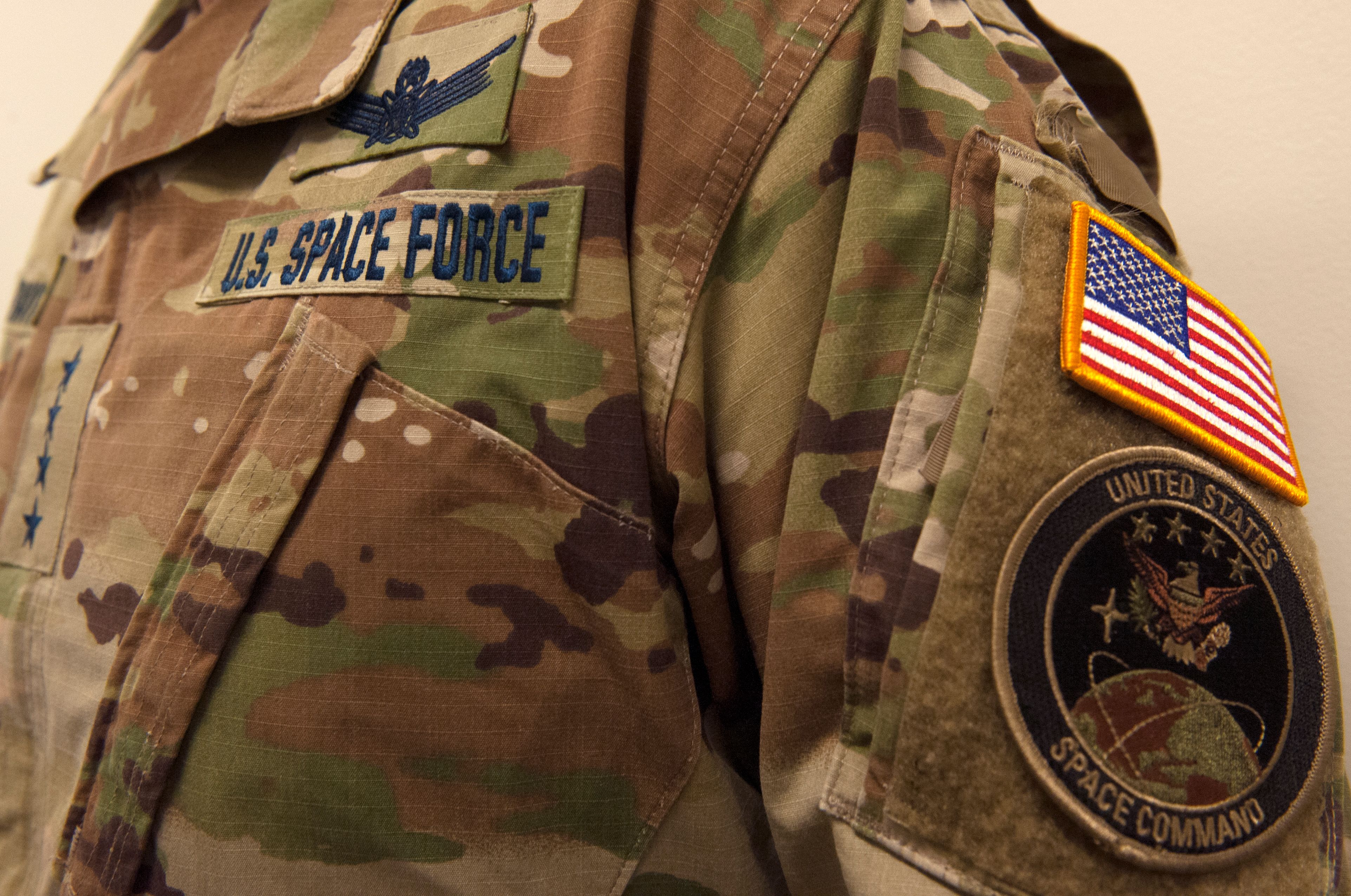
Space Force uniform
The U.S. Space Force puts its own nametape on what looks like a standard-issue woodland camouflage uniform. (U.S. Space Force Photo via Twitter)

The newly minted U.S. Space Force unveiled its uniform on Jan. 17 — and defended its fashion statement against Twitter criticism that the camouflage color scheme should have been more spacey.

Get the news brief on GeekWire.

Categories
GeekWire

Trump signs the Space Force into existence

Trump signs bill into law
President Donald Trump signs the National Defense Authorization Act as VIPs including First Lady Melania Trump, Vice President Mike Pence and Karen Pence look on. (White House via YouTube)

Amid military fanfare, President Donald Trump signed a defense authorization bill into law to create the U.S. Space Force as a sixth branch of the armed forces.

“This is a very big and important moment,” Trump told hundreds of military personnel and VIPs who gathered at Joint Base Andrews in Maryland for today’s signing ceremony.

The Space Force is intended to bring together military resources focusing on the high frontier, including potential threats from GPS jammers, anti-satellite weapons, space-based weapons and hypersonic attack vehicles.

Trump said the creation of the Space Force recognizes that the final frontier has evolved into a distinct warfighting domain.

“American superiority in space is absolutely vital,” he said. “We’re leading, but we’re not leading by enough. But very shortly, we’ll be leading by a lot.”

Get the full story on GeekWire.

Categories
GeekWire

Trump kicks off Space Command; Space Force next?

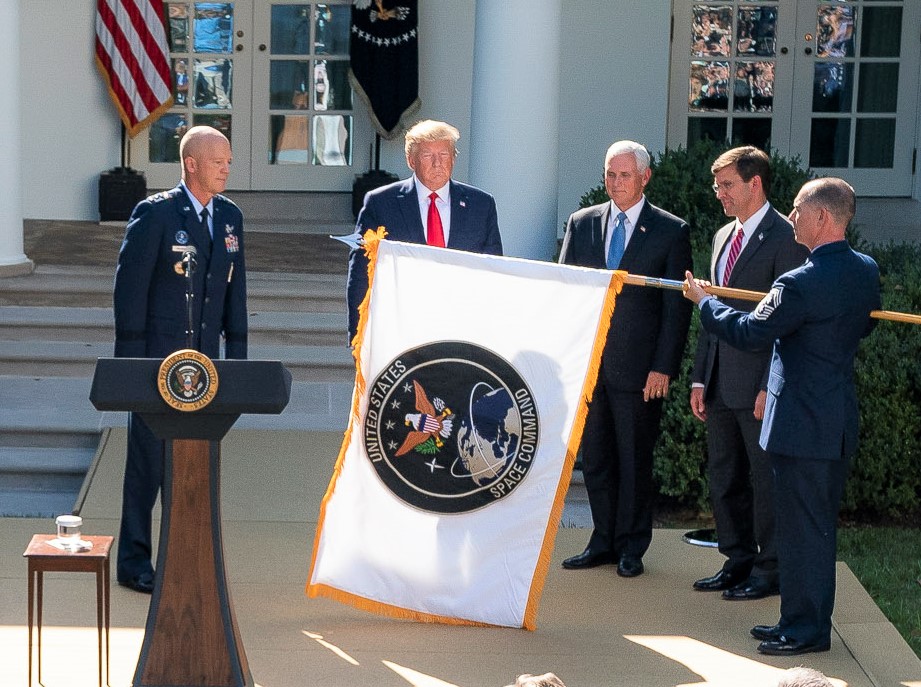
Space Command ceremony
The official flag of the newly revived U.S. Space Command is unfurled at a White House Rose Garden ceremony, with Air Force Gen. Jay Raymond, President Donald Trump, Vice President Mike Pence and Defense Secretary Mark Esper looking on. (White House Photo / Tia Dufour)

President Donald Trump today hailed the revival of the U.S. Space Command to protect America’s technological assets on the final frontier, and put in another pitch for the establishment of a U.S. Space Force as the sixth branch of the armed forces.

“This is a landmark day — one that recognizes the centrality of space to America’s national security and defense,” the president said.

“As the newest combatant command, SPACECOM will defend America’s vital interests in space — the next warfighting domain. And I think that’s pretty obvious to everybody. It’s all about space,” Trump declared during a White House Rose Garden ceremony that was also attended by Vice President Mike Pence, Defense Secretary Mark Esper and other officials.

“This is a landmark day — one that recognizes the centrality of space to America’s national security and defense,” the president said.

After Trump spoke, Esper signed the documents establishing the Space Command.

Get the full story on GeekWire.

Categories
GeekWire

Budget proposal tightens the screws on science

Space Launch System
An artist’s conception shows NASA’s Space Launch System in flight. (NASA Illustration)sls

The White House’s $4.7 trillion spending plan for fiscal year 2020 aims to give a boost to the Space Force, but would dial down work on NASA’s Space Launch System, zero out the Wide Field Infrared Survey Telescope, leave salmon in the lurch and slash science spending on other fronts.

When it comes to outer space, the brightest spotlight falls on lunar exploration and space commercialization — which is in line with the priorities of the National Space Council, headed by Vice President Mike Pence. And when it comes to earthly realms in science and technology, artificial intelligence and quantum computing shine.

It’s important to remember, however, that every year’s budget request is pronounced “dead on arrival” by critics in Congress. That’s particularly so this year, with Democrats in control of the House.

Get the full story on GeekWire.