A Russian Soyuz craft descends through the clouds toward its landing in Kazakhstan, bringing a U.S.-Russian-British crew back down to Earth. (Credit: Bill Ingalls / NASA)
Three spacefliers from the International Space Station made a photogenic return to Earth today, touching down in the steppes of Kazakhstan.
The landing marked the end of a 186-day tour of duty for NASA astronaut Tim Kopra, Britain’s Tim Peake and Russia’s Yuri Malenchenko. The homeward journey began when the trio’s Russian Soyuz capsule undocked from the station at 10:52 p.m. PT Friday, leading up to the parachute-assisted descent through partly cloudy skies a little more than three hours later.
This artist’s concept of NASA’s X-57 Maxwell aircraft shows the plane’s specially designed wing and 14 electric motors. (Credit: NASA Langley / Advanced Concepts Lab / AMA Inc.)
NASA says it has received its first X-plane designation in a decade, for a research aircraft that has 14 electric motors built into a slimmed-down wing. The X-57 hybrid electric airplane picked up a new nickname as well: Maxwell.
NASA Administrator Charles Bolden announced the name and the number today at Aviation 2016, the American Institute of Aeronautics and Astronautics’ annual Aviation and Aeronautics Forum and Exposition. The development highlights the first “A” in the acronym for the National Aeronautics and Space Administration.
“With the return of piloted X-planes to NASA’s research capabilities – which is a key part of our 10-year-long New Aviation Horizons initiative – the general aviation-sized X-57 will take the first step in opening a new era of aviation,” Bolden said in a news release.
The X-plane designation, which applies to experimental airplane built for the government, was assigned by the U.S. Air Force in response to a NASA request. The first X-plane was the X-1 rocket plane, which became the first plane to go supersonic in 1947. The most recent NASA X-plane was the X-48 blended-wing aircraft, which was tested between 2007 and 2012.
Amazon billionaire Jeff Bezos is the founder of Blue Origin. (Credit: Blue Origin)
Amazon billionaire Jeff Bezos says it’s all systems go for a live-streamed Father’s Day launch of Blue Origin’s reusable New Shepard suborbital spaceship, after a postponement due to a leaky O-ring seal.
Blue Origin, the space venture that Bezos founded in 2000, is due to send New Shepard into space from its West Texas launch facility at 7:15 a.m. PT (10:15 a.m. ET) Sunday, Bezos said in a series of tweets. Each of the tweets included a reference to Blue Origin’s motto, “Gradatim Ferociter” (“Step by step, ferociously”).
The test flight had originally been scheduled for today, but on Thursday, Bezos said the faulty O-ring forced a delay.
An artist’s conception shows gravitational waves emanating like ripples in space time as two black holes approach each other in their orbits. (Credit: T. Pyle / LIGO)
t looks as if gravitational-wave watchers are in for a bumpy, beautiful ride. Scientists using the Laser Interferometer Gravitational-Wave Observatory, or LIGO, have confirmed the detection of another merger involving two faraway black holes.
The observations, which were made last Christmas and reported today in a paper published by Physical Review Letters, support the idea that LIGO could open up a whole new branch of astronomy focusing on gravitational disturbances and black holes.
“It is a promising start to mapping the populations of black holes in our universe,” Gabriela Gonzalez, a Louisiana State University astrophysicist who serves as the spokesperson for the LIGO Scientific Collaboration, said in a news release.
She and her colleagues say this smash-up was smaller than the first black-hole merger, which was observed in September and reported by the LIGO team in February. That clash involved black holes that were 29 and 36 times as massive as the sun. This one brought together black holes that were eight and 14 times the sun’s mass.
A 787 jet takes shape at Boeing’s plant in Everett, Wash. (GeekWire photo by Alan Boyle)
Reports from Tehran suggest that Iran’s flag carrier airline has struck a deal to purchase jetliners from the Boeing Co., which would mark a milestone in U.S. commercial relations with the Islamic Republic.
“In coming days, details of the deal with this company will be announced,” the semi-official Mehr news agency quoted Abbas Akhoundi, Iran’s minister of roads and urban development, as saying today.
The Reuters news agency quoted unnamed sources as saying the deal calls for Iran Air to acquire more than 100 Boeing jets, from the company directly and from leasing companies. Iran Air operates under the umbrella of Akhoundi’s ministry.
Such an arrangement would match Iran Air’s provisional agreement to purchase 118 Airbus jets worth as much as $27 billion. Reuters said that the Airbus agreement, announced in January, still requires export licenses from the United States due to the use of significant U.S. technology.
The propylene oxide molecules were detected in a massive star-forming region known as Sagitttarius B2, which is close to the supermassive black hole at the center of our Milky Way Galaxy (noted as Sgr A* in this image). The white features in this composite image are bright radio sources. The background image is from the Sloan Digital Sky Survey. (Credit: B. Saxton / NRAO / AUi / NSF / NRL / SDSS)
Researchers say they’ve found the first evidence of mirror-image molecules in interstellar space – a discovery that relates to the chemistry that gave rise to life here on Earth.
The molecules of propylene oxide were detected in a huge cloud known as Sagittarius B2 North, about 28,000 light-years from Earth, during a scan that used the Green Bank Telescope in West Virginia.
Mirror-image molecules are notable because they come in left-handed or right-handed molecular orientations, like the molecules that serve as the building blocks for life on Earth. That “handedness” is known as chirality.
“This is the first molecule detected in interstellar space that has the property of chirality, making it a pioneering leap forward in our understanding of how prebiotic molecules are made in the universe and the effects they may have on the origins of life,” Brett McGuire, a chemist with the National Radio Astronomy Observatory, said in a news release.
The heavily encrusted bow of the Andrea Doria is dimly visible in this image captured from OceanGate’s Cyclops 1 submersible. (Credit: OceanGate)
A crew of undersea explorers from Everett, Wash., has gotten the best look in decades at the Andrea Doria, an Italian ocean liner that sank 60 years ago off Nantucket.
The hard-to-reach shipwreck has been called the “Mount Everest of scuba diving.” But this Everest is crumbling more quickly than expected, the OceanGate crew reported.
OceanGate CEO Stockton Rush told reporters at a Monday news conference in Boston that the ship looks “dramatically different” from images captured during previous dives. More than a dozen sonar images reveal that a significant portion of the ship’s hull has decayed, 240 feet beneath the Alantic Ocean’s surface. A large section of the bow appears to have broken off.
“Imagine it as a collapsing cave,” the Boston Globe quoted Rush as saying. “Once the cave loses its basic structure, it deteriorates very quickly.”
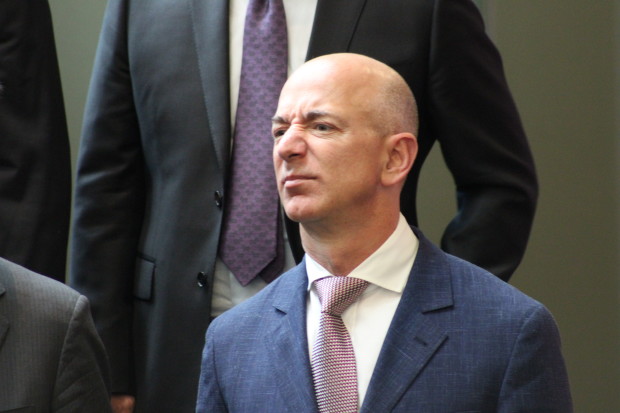
Amazon CEO Jeff Bezos at a U.S.-China Internet Industry Forum in Seattle in September 2015.
Billionaire presidential candidate Donald Trump took aim once again at Amazon billionaire Jeff Bezos as he revoked the campaign credentials for the newspaper Bezos owns, The Washington Post.
Today the presumptive GOP nominee added the Post to a list of banned media outlets that also includes BuzzFeed, The Daily Beast, The Des Moines Register, The Huffington Post, the New Hampshire Union Leader, The Huffington Post, Politico, Univision and others. Reporters from banned outlets have been denied credentials to cover Trump’s campaign events.
The reason for today’s ban was the headline on a Post story reporting Trump’s criticism of President Barack Obama over his response to this weekend’s mass shooting at a nightclub in Orlando, Fla.
Blue Origin’s New Shepard spaceship lifts off for a test in January. (Credit: Blue Origin)
For his next trick, Amazon billionaire Jeff Bezos plans to have his Blue Origin space venture send its New Shepard rocket ship into outer space and back with one bum parachute on Friday – and live-stream the whole thing.
Allowing live video of a rocket launch and landing is old hat for the likes of rival billionaire Elon Musk and his company, SpaceX, but Blue Origin has never done it before. Bezos’ announcement indicates that the once-secretive company is becoming more comfortable sharing its accomplishments with the public as they happen.
Friday will mark the fourth go-around for this particular New Shepard suborbital vehicle at Blue Origin’s West Texas testing ground. The first suborbital flight test was done last November, followed by similarly successful outings in January and April. Each time, a booster powered by Blue Origin’s hydrogen-fueled BE-3 rocket engine sent an uncrewed space capsule to a height beyond 62 miles, the internationally accepted boundary of outer space.
A visualization shows T-cells communicating via the immune synapse. (Credit: Alpine BioVentures)
Seattle’s Alpine Immune Sciences says it has closed a $48 million Series A financing round, to fund the development of next-generation therapies that tweak the body’s immune system to fight cancer and autoimmune diseases.
Immunotherapy ranks among the hottest topics in cancer research nowadays. The company’s executive chairman and acting CEO, Mitchell Gold, said in a statementthat the new infusion of investment “recognizes the tremendous potential” for the field and for Alpine Immune Sciences.
“AIS is taking a unique approach to modulating the immune system through the directed evolution of naturally occurring ligands – creating the next generation of cancer and autoimmune therapeutics with our vIgD platform,” Gold said.
The company is working on drugs that can activate the immune system to attack cancer cells, or keep the immune system from attacking healthy cells. The stand-down effect could ease such autoimmune disorders as Crohn’s disease, lupus and arthritis.