An artist’s conception shows a lunar lander with scientific payloads. (NASA Illustration)
NASA has chosen three commercial ventures that haven’t yet launched anything into space to deliver science experiments to the moon’s surface, starting next year.
Today’s awards are the first to be announced under the terms of the space agency’s Commercial Lunar Payload Services program, or CLPS, which draws from a “catalog” of flight opportunities offered by nine commercial teams.
Each team proposed flying specific payloads to the moon, and this summer NASA will determine which experiments will be delivered by which teams. The potential payloads focus on subjects ranging from basic lunar science to precision navigation and solar power generation.
Science-fiction author Neal Stephenson, shown here at a 2018 Town Hall event in Bellevue, Wash., uses Seattle as a setting in his latest novel, “Fall; or, Dodge in Hell.” (GeekWire Photo / Alan Boyle)
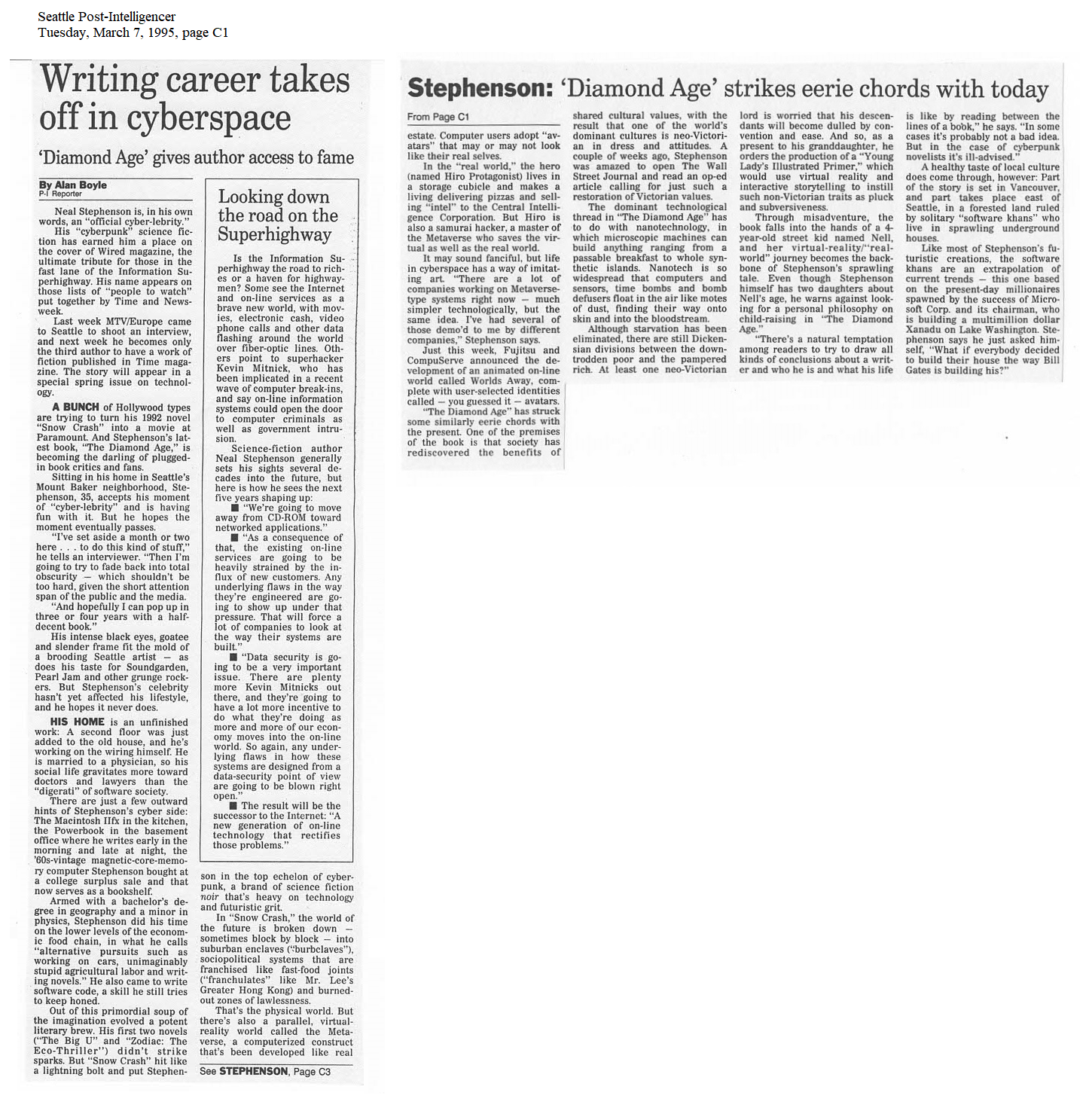
Are we living in a simulation? Is there an afterlife? And if not, what would it take to create one? Seattle science-fiction author Neal Stephenson knits together ideas as old as the Bible and as up to date as Elon Musk’s musings in an epic 880-page novel titled “Fall; or, Dodge in Hell.”
“Fall” takes its rightful place alongside Stephenson’s earlier works, including 1991’s “Snow Crash,” which anticipated the rise of virtual and augmented reality; 1995’s “The Diamond Age,” which celebrated nanotechnology and neo-Victorianism; and 2015’s “Seveneves,” a tale that started with the moon’s mysterious destruction.
Microsoft co-founder Bill Gates rated “Seveneves” among his favorite books, saying that it contained “so many cool ideas, memorable characters and good storylines that I can’t cover them all.” I can hardly wait to hear what he says about Stephenson’s latest.
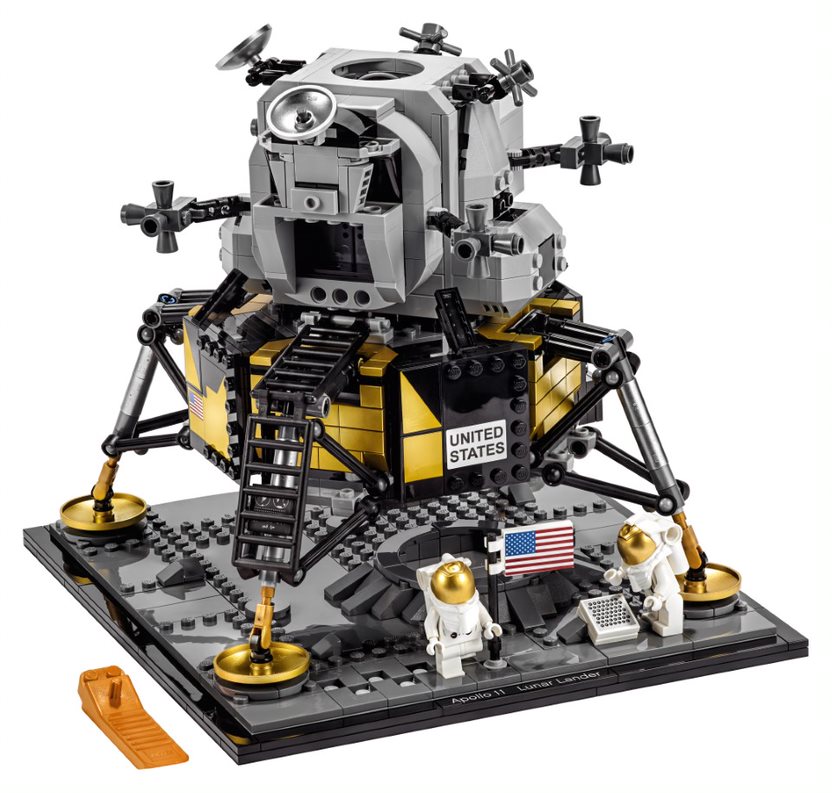
Lego’s minifigure recreation of the Apollo 11 lunar landing comes with a moonscape. (Lego Photo)
That’s one giant heap of Lego bricks: To celebrate the 50th anniversary of the Apollo 11 moon landing, the Lego Group is unveiling a 1,087-piece building set that recreates the mission’s Eagle lunar module.
The Lego Creator Expert NASA Apollo 11 Lunar Lander model, developed in cooperation with NASA, consists of an ascent stage with a detailed interior, plus a descent stage with a ladder and hatches that open.
Two astronaut minifigures are included in the kit, along with a depiction of the lunar surface complete with a crater, moon footprints and a U.S. flag.
In a news release, the company said the $99.99 set will be exclusively available at Lego stores and via the Lego Shop website beginning June 1.
Russian spacewalkers Oleg Kononenko and Alexey Ovchinin work outside the International Space Station’s Pirs docking compartment. (NASA TV)
Two Russian cosmonauts took care of a host of scientific and maintenance choreson the exterior of the International Space Station, including cleaning windows from the outside, during a spacewalk that lasted just a minute over six hours.
In his honor, cosmonauts Oleg Kononenko and Alexey Ovchinin wore orange placards praising Leonov on their spacesuits during today’s extravehicular tasks. They also showed off a photo of Leonov that they carried outside with them.
“Mr. Leonov, please accept our heartfelt birthday wishes,” one of the spacewalkers said. “You’re with us here and now in outer space, and for the entire duration of this spacewalk you will be here with us.”
One of the companies in Breakthrough Energy Ventures’ portfolio is Sweden’s Baseload Capital, which invests in geothermal facilities including Varmaorka in Iceland. (Photo Courtesy of Baseload Capital)
Microsoft co-founder Bill Gates is celebrating the official launch of Breakthrough Energy Ventures Europe, an investment fund that aims to boost clean-energy innovation in Europe to the tune of 100 million euros. That translates to $112 million at the current rate of exchange.
Breakthrough Energy Ventures was created in 2016 to invest in zero-carbon energy technologies, and it’s laid down bets on 15 ventures since then. But most of those ventures are based in the U.S. and Canada. Breakthrough Energy Ventures Europe, or BEV-E, will make sure Europe is well-represented on the clean-energy frontier.
An artist’s conception shows Blue Origin’s concept for a space station. (Blue Origin / NASA Illustration)
Amazon CEO Jeff Bezos’ Blue Origin space venture has laid out a plan for building a commercial habitat for future space travelers and sending it into Earth orbit atop its New Glenn rocket.
The concept is one of a dozen studies that NASA released today as part of a project to assess how crewed space operations in low Earth orbit, or LEO, could be commercialized within the next six years or so.
NASA commissioned the studies last summer to investigate commercial alternatives to the International Space Station, in line with the current plan to move away from government management and operation of the space station’s U.S. segment by 2025. Each of the 13 teams was tasked with providing a study at a cost of no more than $1 million, with the total price tag adding up to an estimated $11 million..
In addition to Blue Origin’s concept presentation, NASA released study summaries from Axiom Space, Boeing, Deloitte Consulting, KBRwyle, Lockheed Martin, McKinsey & Co., NanoRacks, Northrop Grumman, Sierra Nevada Corp., Space Adventures and Space Systems/Loral (now part of Maxar Technologies). Bigelow Aerospace was also on NASA’s original list to do a study, but didn’t come in for a mention today.
Books about the moon can help get you in the proper mood to see the “Destination Moon” exhibit at Seattle’s Museum of Flight. (GeekWire Photo / Alan Boyle)
In the 50 years since Apollo 11 astronaut Neil Armstrong left humanity’s first bootprint on the moon, that “one small step” has launched one giant load of books.
Basketfuls of books about space are now hitting store shelves — not only to mark the golden anniversary of that first moon landing, but also to provide the context for a renewed focus on lunar exploration.
Whether you’re looking for an Apollo book you can read to your kids, an award-winning sci-fi novel about alternate space history, or up-to-date management tips gleaned from the early space effort, we’ve got you covered. Here are 18 recently published (or updated) books that are well-suited for this year’s summer of space, plus a couple of bonus picks.
A still from a video captured by Dutch satellite-watcher Marco Langbroek shows a string of Starlink satellites moving through the night sky. (Marco Langbroek via Twitter)
After a couple of days of debate in the Twitterverse, SpaceX CEO Elon Musk said steps would be taken to minimize the impact of the Starlink satellites’ shine on astronomical observations.
Inspired by the paper folding art of origami, a University of Washington team — including Jinkyu Yang, an associate professor of aeronautics and astronautics — created a paper model of a metamaterial that uses folding creases to soften the force of an impact. (UW Photo / Kiyomi Taguchi)
Can origami protect football players and reusable rockets? Researchers have shown how the ancient art of paper-folding can soften the shock of an impact, whether it’s cracking into a helmet or touching down on a landing pad.
“If you were wearing a football helmet made of this material and something hit the helmet, you’d never feel that hit on your head. By the time the energy reaches you, it’s no longer pushing. It’s pulling,” senior author Jinkyu Yang, associate professor of aeronautics and astronautics at the University of Washington, said in a news release.
That’s not to say that future football helmets will be made of paper. But the engineering principles that Yang and his colleagues tested with paper models could well be translated into new types of shock-absorbing structures for rocket landing legs, automotive vehicles and other applications.
The higher-than-expected investments were reported today in two amended filings with the Securities and Exchange Commission. One financing round, which was opened last December, netted $486 million. The other, which opened last month, brought in $535 million. And between the two rounds, there was still $18.8 million in equity to offer, according to the filings.