Categories
GeekWire

T. rex delivered to Seattle, with more to come

Image: T. rex skull in plaster
Workers unload a plaster-wrapped T. rex skull at the Burke Museum. (GeekWire photo by Alan Boyle)

Seattle’s Burke Museum took delivery of what’s recognized as one of the finest Tyrannosaur rex skulls in the world today, but there are still more bones out in Montana to add to the treasure.

“We’ll go back again,” Greg Wilson, a University of Washington biologist who led the excavation team at Montana’s Hell Creek Formation, told GeekWire at the arrival ceremony. “There’s more in the hill.”

It’ll take more than a year to do the preparatory work on the skull and more than 50 other T. rex bone specimens that have been recovered over the past couple of months, including vertebrae, ribs, hips and lower jaw bones.

The haul so far appears to account for about 20 percent of the complete skeleton. That puts the Burke Museum’s set of fossils among the world’s top 25 T. rex finds, Wilson said. He told reporters that the museum’s T. rex skull will be the only one to go on public display in Washington state.

Get the full story on GeekWire.

Categories
GeekWire

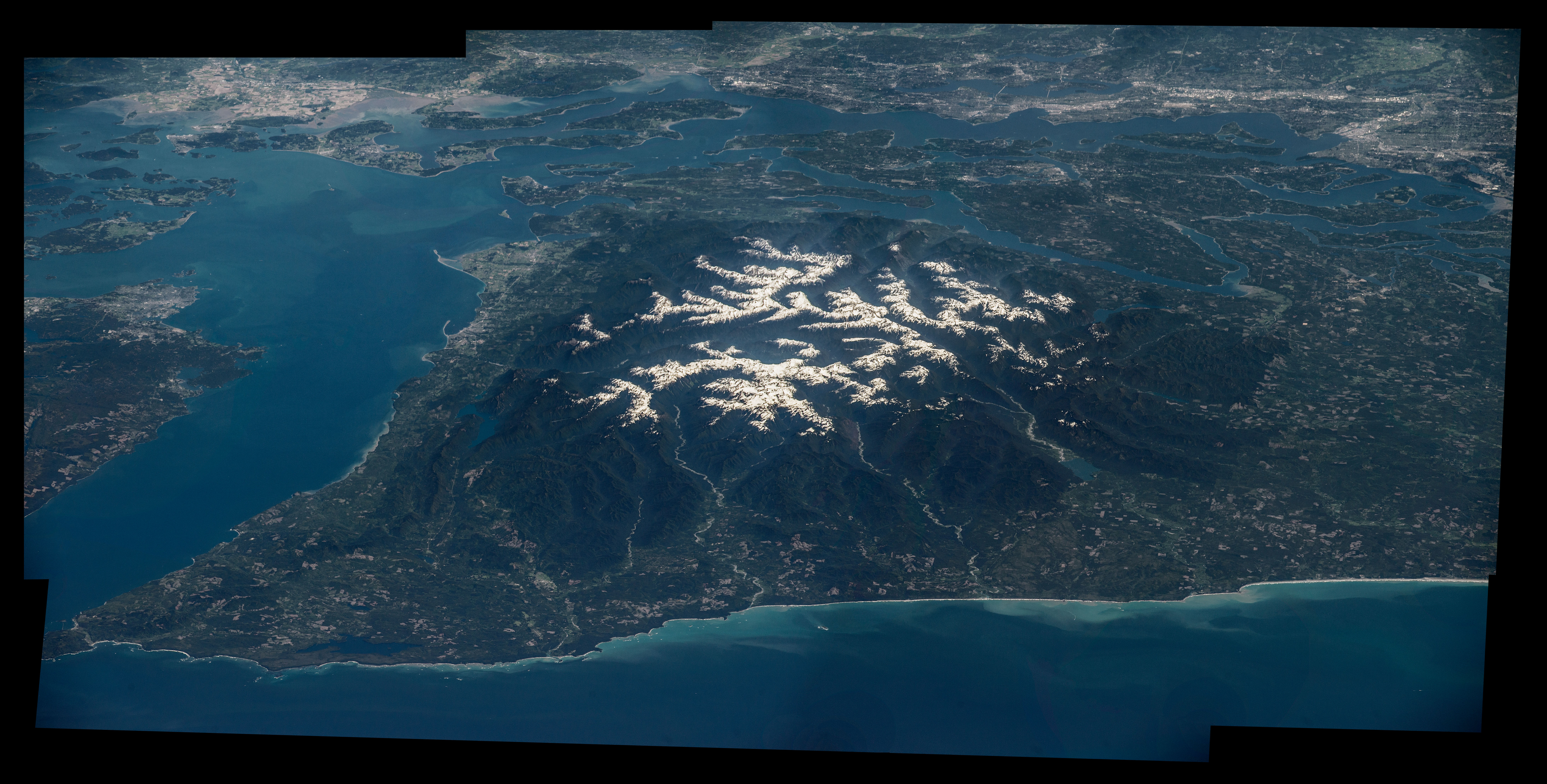
Olympic Peninsula gets its orbital close-up

Image: Olympic Peninsula seen from space
Images captured from the International Space Station on May 6 were combined to create this panorama of Washington state’s Olympic Peninsula, with Seattle and Tacoma in the background. Click on the picture for a larger version. (Credit: NASA)

You can see the snow dusting the tops of the Olympic Mountains in a newly released portrait captured from the International Space Station.

But if you think that’s something, try looking for the ships plying Puget Sound and the bridges crossing Lake Washington in the high-resolution view from NASA.

The panorama was assembled from seven photos taken from orbit on May 6, and tweeted out by NASA astronaut Jeff Williams today.

Get the full story on GeekWire.

Categories
GeekWire

Seattle’s Burke Museum is getting a T. rex

Image: Lifting T. rex skull
Among the treasures found in Montana’s Hell Creek Formation was a reasonably complete T. rex skull, which was encased in plaster for shipment. (Credit: Burke Museum)

Paleontologists from Seattle’s Burke Museum of Natural History and Culture have discovered the fossil remains of a Tyrannosaurus rex, including a 4-foot-long skull, and they’re bringing the goods home with them.

The plaster-encased dinosaur skull, which weighs 2,500 pounds, will be unloaded from a flatbed truck at the museum on Aug. 18.

The Burke Museum says the research team excavated the reasonably complete skull, as well as pieces of the T. rex’s lower jawbone, vertebrae, ribs and teeth, during this year’s field season at the Hell Creek Formation in northern Montana.

Get the full story on GeekWire.

Categories
GeekWire

‘Interscatter’ tech opens new data frontiers

Image: 'Interscatter' contact lens
University of Washington researcher Vikram Iyer holds up a contact lens that’s been fitted with interscatter electronics. (Credit: Mark Stone / University of Washington)

Contact lenses and brain implants that can transmit data may sound like science-fiction gizmos  but researchers at the University of Washington are turning them into science fact, thanks to a technological trick they call interscatter communication.

The technology relies on super-low-power devices that can reflect wireless transmissions such as Bluetooth signals, transforming them into data-carrying Wi-Fi signals in the process.

Such devices require mere millionths of a watt to work, and can be shrunk down to the size of a computer chip. The technique is described in a paper to be presented next week at the Association for Computing Machinery’s SIGCOMM 2016 conference in Brazil.

The researchers developed interscatterers shaped like contact lenses and brain implants as test cases.

“Wireless connectivity for implanted devices can transform how we manage chronic diseases,” Vikram Iyer, a UW electrical engineering doctoral student, said today in a news release. “For example, a contact lens could monitor a diabetics blood sugar level in tears and send notifications to the phone when the blood sugar level goes down.”

Get the full story on GeekWire.

Categories
GeekWire

Carbon fiber report sparks SpaceX speculation

Image: Falcon Heavy launch
An artist’s conception shows a Falcon Heavy rocket lifting off for Mars. (Credit: SpaceX)

Is SpaceX planning to buy billions of dollars’ worth of carbon fiber for future Mars-bound spaceships? The answer’s up in the air, but a report to that effect from Japan’s Nikkei Asian Review has set SpaceX’s fans abuzz.

The report claims that SpaceX and Toray Industries, a Japan-based fiber manufacturer, are working on a multiyear deal that could eventually be worth $2 billion to $3 billion (200 billion to 300 billion yen). “The two sides are aiming to finalize the agreement this fall after hammering out prices, time frames and other terms,” Nikkei Asian Review’s Yuichiro Kanematsu reported.

No sources were cited in the report, and SpaceX downplayed any suggestion that a deal had been reached.

“Toray is one of a number of suppliers we work with to meet our carbon fiber needs for Falcon rocket and Dragon spacecraft production, and we haven’t announced any new agreements at this time,” SpaceX spokesman Phil Larson told GeekWire in a text. “As our business continues to grow, the amount of carbon fiber we use may continue to grow.”

Get the full story on GeekWire.

Categories
GeekWire

Ford plans fully autonomous cars by 2021

Image: Ford autonomous car
Ford plans to have fully autonomous vehicles available for mobility services by 2021. (Credit: Ford)

Ford Motor Co. says it’s aiming to mass-produce fully autonomous vehicles for ride-sharing and ride-hailing services within five years – and it’s investing tens of millions of dollars in ventures that could help the company hit that goal.

“We see autonomous vehicles as having as significant an impact on society as Ford’s moving assembly line did more than 100 years ago,” Ford President and CEO Mark Fields said today at the company’s Research and Innovation Center in Palo Alto, Calif. “And that’s why today we’re announcing Ford’s intent to have a high-volume, SAE Level 4, fully autonomous vehicle in commercial operation in 2021.”

To meet that timetable, Fields said the Silicon Valley center’s staff would be doubled to more than 300 – and that’s not all.

Get the full story on GeekWire.

Categories
GeekWire

Amazon provides a peek at delivery drone design

Image: Amazon drone design
A figure from Amazon’s patent application shows how a delivery drone’s rotors would be encased in a protective shroud. (Credit: Amazon via USPTO)

A newly published patent application almost literally delves into the nuts and bolts of the package-delivering drones that Amazon is developing – but it also makes clear that the look of the drones could vary, depending on where and how they’re being used.

The proposed designs include quadcopters and octocopters, drones with motors as wide as 18 inches that are mounted vertically to push the craft and its cargo through the air, and drones with fixed wings that extend well beyond the craft’s protective shroud.

That safety shroud is the common thread in all of the described designs.

The application was filed in December 2014 by Gur Kimchi and Rick Welsh, two of the lead engineers for Amazon Prime Air, but published by the U.S. Patent and Trademark Office only last week.

Get the full story on GeekWire.

Categories
GeekWire

Why small satellites are big for startups

Image: Arkyd 6
An artist’s conception shows Planetary Resources’ Arkyd 6 prototype Earth-observing satellite, which is due for its maiden launch this year. (Credit: Planetary Resources)

Small satellites, and the startups that make them, are becoming a big deal – and there’s a fresh flurry of industry reports that explain why.

The bottom line is that new types of satellite data can give earthbound businesses an edge.

For example, a hedge-fund manager can estimate how much revenue Walmart will report by counting the cars in the stores’ parking lots. Farmers can use custom-delivered, hyperspectral imaging to monitor how their crops are doing. Petroleum companies can get a quick alert on potential pipeline leaks.

Seattle-area companies like Planetary Resources and Spaceflight Industries are betting millions of dollars on the rapid growth of next-generation satellite services. And then there’s the rush to deliver internet services via satellite: That’s the focus of SpaceX’s Seattle office.

Get the full story on GeekWire.

Categories
GeekWire

Blue Angels jet will be trucked to Seattle

Image: Blue Angels jet
The U.S. Navy Blue Angels perform at Seafair 2015 in Seattle. (GeekWire photo by Kevin Lisota)

A 30-year-old Navy F/A-18 Hornet jet that’s been through combat duty as well as a dozen years with the Blue Angels is being packed up in Florida for ground delivery to Seattle’s Museum of Flight.

Museum spokesman Ted Huetter told GeekWire that the partially disassembled airplane will travel from the Blue Angels’ home base at Pensacola Naval Air Station by truck. “It is going to be making its way across the country this week,” he said today.

Arrival is expected sometime in the Aug. 21-23 time frame. Huetter said the museum is planning to provide updates on the shipment’s progress via social media.

The Navy is phasing out the Hornets, and the Blue Angels’ fleet is expected to get anupgrade to the heavier F/A-18E and F/A-18F Super Hornets by as early as next year.

Get the full story on GeekWire.

Categories
GeekWire

Microsoft and MIT unveil smart tattoos

Image: DuoSkin smart tattoo
A DuoSkin touch-slider tattoo uses gold and silver leaf. (Credit: Jimmy Day / MIT)

Smart tattoos made out of super-thin electronics have been a thing for years, but now the technology is getting closer to fashionable prime time.

Microsoft Research has joined forces with MIT Media Lab for the latest iteration, dubbed DuoSkin. The skin-friendly process is the subject of a paper to be presented next month in Heidelberg, Germany, at the International Symposium on Wearable Computers.

“DuoSkin draws from the aesthetics found in metallic jewelry-like temporary tattoos to create on-skin devices which resemble jewelry,” the research team reports in its paper about the technology.

The tattoos consist of artistic arrangements of conductive gold and silver leaf, plus tissue-thin electronics.

Apply an array of the circuitry to your forearm, using a water transfer method similar to that used for everyday temporary tattoos, and you have a trackpad or touchpad to control a music player or smartphone.

Other applications include tattoos that can change color or light up to reflect your mood, and an antenna tattoo that can transmit data via Bluetooth or near field communications (a.k.a. NFC).

Get the full story on GeekWire.