Categories
GeekWire

Wayward boat blamed after aborted launch

Image: SpaceX launch abort
The Falcon 9 rocket’s engines flare during a last-second shutdown. (Credit: SpaceX via YouTube)

A wayward boat and a load of liquid oxygen that got too warm forced SpaceX to abort what might have been a successful launch of the SES-9 telecommunication satellite today, just as the engines were firing up.

The snags mean SpaceX will have to wait until at least Tuesday for the next opportunity to launch its Falcon 9 rocket from Cape Canaveral Air Force Station in Florida, and to try landing the first-stage booster on an oceangoing platform in the Atlantic.

Today marked the third scrub for the launch, which is aimed at putting Luxembourg-based SES’ satellite into orbit to provide TV and data services to customers in the Asia-Pacific region. The first two delays were due to concerns over chilling down the rocket’s liquid oxygen propellant to the optimal temperature. Liquid oxygen played a role in today’s postponement as well, but there were a couple of additional twists.

The countdown was held up for more than a half-hour because an unauthorized vessel was in the “keep-out zone,” which is meant to keep boat traffic out of harm’s way as the rocket passes overhead. After a helicopter went out to shoo the ship out of the zone, SpaceX got clearance to launch at 7:21 p.m. ET (4:21 p.m. PT).

When the countdown clock reached zero, the engines flared up – and then immediately shut themselves down.

SpaceX’s billionaire founder, Elon Musk, said in a tweet that the shutdown was triggered by a low-thrust alarm about the engines. He said rising temperatures in the liquid oxygen tanks contributed to the weak thrust, and suggested that the launch might have gone ahead if it weren’t for the earlier countdown hold.

Get the full story on GeekWire.

Categories
GeekWire

Pluto’s polar canyons get their close-up

Image: Pluto north polar region
This enhanced-color image was obtained by New Horizons’ MVIC camera about 45 minutes before closest approach on July 14, 2015, when the spacecraft was 21,100 miles away. The lower edge of the image measures about 750 miles long. (Credit: NASA / JHUAPL / SwRI)

The heart-shaped region along Pluto’s equator has been the darling of NASA’s New Horizons mission, but it’s the north polar region that gets the love in this week’s featured image.

The area seen here is part of a region informally known as Lowell Regio. That’s a tribute to Percival Lowell, the millionaire astronomer who sparked the search that eventually led to Pluto’s discovery.

Toward the left side of the image, there’s a canyon that measures about 45 miles wide. Other canyons, to the east and west, are about 6 miles wide. These formations hint at tectonic activity in ancient times, according to the New Horizons science team.

Near the lower right corner, there are irregularly shaped pits that span as much as 45 miles. The science team says those pits are about 2.5 miles deep, and may indicate locations where subsurface ice has been lost from below. That would have caused the surface layer to collapse into the void.

Get the full story on GeekWire.

Categories
GeekWire

‘Martian’ flower basks in the Oscar glow

Image: Solanum watneyi
The bush tomato called Solanum watneyi has purple flowers. (Chris Martine / Bucknell / CC-BY 4.0)

Timing is everything, even when it comes to naming plant species. Bucknell University botanist Chris Martine found that out last fall, when he announced that a newly identified species of Australian bush tomato would be named after Mark Watney, the central character in a little movie called “The Martian.”

The announcement about Solanum watneyi made a splash, in part because it came just as the hype over the movie was reaching a crescendo.

Now there’s a second splash: The description of the plant is being published in the journal PhytoKeys – just as “The Martian” and Matt Damon, the actor who played Mark Watney, are basking in the glow of the Academy Awards spotlight.

Get the full story on GeekWire.

Categories
GeekWire

Acoustic imager makes sound visible

Image: Acoustic image
A color-coded image of an industrial site pinpoints sound coming from a passing truck as well as from equipment on the other side of a buildling. (Credit: Signal Interface Group)

Not even the click of a pen or the rustle of a shirt goes undetected by Signal Interface Group’s acoustic imager. But how about a person’s, um, rude noises?

“We don’t record those,” the company’s president, Neil Fenichel, says with a smile.

The gizmo that Fenichel demonstrated this week at Signal Interface Group’s office in Bellevue, Wash., is designed for higher purposes: to find out why an elevator is whining, where an air-conditioning system is leaking, which fluorescent light is buzzing, why a car’s engine is making a funny sound, or even how a hummingbird does its buzz.

The imaging system, developed in cooperation with Bellevue-based OptiNav, combines several tricks of the acoustic trade.

Get the full story on GeekWire.

Categories
GeekWire

Next-gen B-21 bomber’s design unveiled

Image: B-21 design
The Air Force’s B-21 bomber has that characteristic stealthy look. (Credit: USAF)

Today the U.S. Air Force took the wraps off the design for its Long Range Strike Bomber, now known as the B-21, and said it’d be taking suggestions for a snappier name from its service members.

“This aircraft represents the future for our airmen, and (their) voice is important to this process,” Air Force Secretary Deborah Lee James said in a news release. The announcement was made at the Air Force Association’s Air Warfare Symposium in Orlando, Fla.

James said the person who suggests the winning name would help her announce it at this fall’s Air Force Association conference. Further information on the naming procedure will be made available via the Air Force’s website as well as Facebook and Twitter.

Last October, Northrop Grumman won the contract to develop the B-21, which could ultimately be worth $80 billion or more.

Get the full story on GeekWire.

Categories
GeekWire

Navy investigates mystery drone sighting

Image: Drone
Drones are raising issues as they become more widespread. (Credit: DJI)

The Navy has confirmed that it’s investigating the illegal flight of an unidentified drone over Naval Base Kitsap-Bangor, the home base for Trident submarines that carry nuclear weapons.

In an email, Navy spokeswoman Silvia Klatman said the drone was sighted in prohibited airspace by a civilian employee on Feb. 8.

“Any operation over the base without prior permission and coordination with appropriate authorities is both illegal and hazardous,” she said. “It’s our intent to support the investigation and prosecution of this reported act, and any others that may occur, in coordination with civilian law enforcement.”

The Seattle Times and the Kitsap Sun quoted a nearby resident, Al Starcevich, as saying that he and his neighbors were interviewed by investigators last week, and that he was told there were repeated drone flights at night.

Get the full story on GeekWire.

Categories
GeekWire

Scott Kelly: I could do another year in space

Image: Scott Kelly
NASA astronaut Scott Kelly answers questions from the International Space Station. (Credit: NASA)

NASA astronaut Scott Kelly is getting ready to come home after spending a longer stretch in orbit than any other American in history, but he says he could stay in space for double that time.

“I could go another 100 days. I could go another year if I had to. It would just depend on what I was doing and if it made sense, although I do look forward to getting home here next week,” he told journalists today during a space-to-ground news conference.

The next few days will cap off a 340-day tour of duty on the International Space Station, which is aimed at studying how long-duration spaceflight could affect astronauts during even longer trips to Mars and back.

Kelly and his fellow year-in-spacer, Russian cosmonaut Mikhail Kornienko, are due to come back to Earth in a Soyuz capsule along with Russian crewmate Sergey Volkov on March 1.

Get the full story on GeekWire.

Categories
GeekWire

Will self-driving cars be good for the planet?

Image: Self-driving car
Volvo’s SARTRE project is aimed at developing fuel-saving approaches to autonomous driving, such as “platooning.” SARTRE stands for “Safe Road Trains for the Environment.” (Credit: Volvo)

Experts expect self-driving cars to make the roads much safer, and driving much more convenient. But what will they do to the environment? A newly published study suggests that, under some scenarios, the shift to autonomous vehicles could double energy use and greenhouse-gas emissions.

The good news is that other scenarios could lead to a nearly 50 percent reduction in those metrics by 2050, which would brighten the picture for coping with climate change. It all depends on how driverless cars are introduced into the marketplace, and how consumers and businesses respond.

“There is lots of hype around self-driving cars, much of it somewhat utopian in nature. But there are likely to be positives and negatives,” University of Washington engineering professor Don MacKenzie said. “By taking a clear-eyed view, we can design and implement policies to maximize the benefits and minimize the downsides of automated vehicles.”

MacKenzie is one of the authors of a study analyzing the range of possibilities, published today in the journal Transportation Research Part A. The survey comes as a plethora of companies, ranging from Ford and Tesla to Google and Apple, are hustling to make vehicles more autonomous and jump through regulatory hoops.

Get the full story on GeekWire.

Categories
GeekWire

So close! SpaceX holds up launch (and landing)

Image: SpaceX Falcon 9 rocket
A SpaceX Falcon 9 sits on its launch pad at Cape Canaveral Air Force Station. (Credit: SpaceX)

For the second day in a row, SpaceX scrubbed the launch of the SES-9 telecommunications satellite as well as the Falcon 9 rocket landing attempt that was due to follow.

The abort came with just 1 minute and 41 seconds left before the scheduled 3:47 p.m. PT (6:47 p.m. ET) liftoff from Cape Canaveral Air Force Station in Florida.

“Right now, preliminary [word] is that we were still evaluating the liquid oxygen propellant load, looking at how much time we had left in the count to finish loading the liquid oxygen, and at that time the launch team decided that we would need to hold the countdown,” SpaceX launch commentator John Insprucker said.

Get the full story on GeekWire.

Categories
GeekWire

How much should drones and people mix?

Image: Photographer with drone
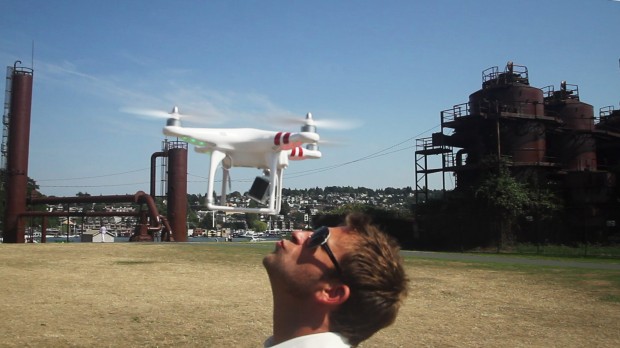
Photographer Chase Jarvis with a drone at Gas Works Park in Seattle.

What are the rules for letting a drone get in your face? Right now, there are no rules, but today the Federal Aviation Administration said it’s setting up a committee to come up with a proposal.

The announcement marks the latest step in the FAA’s effort to get a handle on the rapidly rising fleets of small drones, also known as unmanned aircraft systems or UAS.

A year ago, regulators issued draft rules for the operation of commercial drones, like the ones Amazon is working on for package deliveries. Last December, the FAA set up a system for registering recreational drones. Now the FAA and industry representatives will be taking on one of the thornier questions relating to drones: How close can they get to the folks who aren’t operating them?

The newly announced aviation rulemaking committee is due to begin its work in March, and issue its final report to the FAA on April 1.

Get the full story on GeekWire.