Categories
GeekWire

DNA evidence zeroes in on 3 African ivory cartels

Elephant tusks
Elephant tusks from an ivory seizure in 2015 are laid out in Singapore after they have been sorted into pairs. (Center for Conservation Biology / University of Washington)

DNA evidence and lots of detective work have revealed the networks behind illegal trade in African elephant ivory, centering on three smuggling cartels in Kenya, Uganda and Togo.

The case is laid out in a paper written by a team led by Samuel Wasser, head of the University of Washington’s Center for Conservation Biology, and published today in the open-access journal Science Advances.

Wasser said the findings could figure in a complex case centering on Feisal Mohamed Ali, a reputed ivory kingpin based in Mombasa, Kenya. Feisal was convicted on trafficking charges in 2016 but was set free last month on appeal, due to problems with the evidence that was at hand for the trial.

“Our hope is that the data presented in this paper, and discovered by others, can help strengthen the case against this cartel, and tie Feisal and his co-conspirators to multiple large ivory seizures,” he said.

In addition to the Mombasa cartel, the DNA evidence points to Entebbe in Uganda and Lome in Togo as centers of the illegal African ivory trade.

Get the full story on GeekWire.

Categories
GeekWire

Scientists in a sub explore the Salish Sea

OceanGate's Cyclops 1 sub
OceanGate’s Cyclops 1 submersible prepares to dive in the waters off San Juan Island as a Washington state ferry passes by in the background. (GeekWire Photo / Alan Boyle)

FRIDAY HARBOR, Wash. — This week’s Salish Sea Expedition is unfolding amid the heavily trafficked waters off the San Juan Islands, but there’s still plenty of room here for scientific discoveries.

For example, researchers riding a deep-water submersible called Cyclops 1 announced that they discovered a new low for the feeding grounds of a prickly marine species known as the red sea urchin.

“We extended the range of red urchins to 284 meters,” Alex Lowe, a marine biologist at the University of Washington, proudly declared at UW’s Friday Harbor Laboratories, which is serving as the base of operations for this week’s expedition.

The expedition aims to assess the health of the habitats and species in the Salish Sea, a body of water that takes in the coastal waterways around the U.S.-Canadian border, from the Strait of Georgia to Puget Sound. The Salish Sea offers a rich ecosystem as well as a tourist destination and an increasingly busy shipping lane, but its murky waters make it challenging to study in depth — and at depth.

To remedy that, the expedition’s organizers are making use of Cyclops 1, a five-person craft that can descend far deeper than scuba divers go.

The survey expedition is a joint undertaking that involves scientists from the UW and other research institutions, with support from the non-profit SeaDoc Society and the OceanGate Foundation. Everett, Wash.-based OceanGate, which built Cyclops 1, is playing the lead role in getting the researchers to their underwater destinations.

Get the full story on GeekWire.

Categories
GeekWire

Researchers test new systems to track drones

Drone experiment
The University of Washington’s Cory Cantey and Karine Chen prepare a drone nicknamed Papaya for flight at the Columbia Gorge Regional Airport. (UW Autonomous Flight Systems Laboratory Photo)

As more and more drones fill the skies, increasingly sophisticated methods will be required to track them under increasingly challenging conditions. How will they navigate if they lose touch with the Global Positioning System? How will authorities know who to call if a drone goes wrong?

Two experiments illustrate how those questions are being addressed. One is being conducted by University of Washington researchers at the Columbia Gorge Regional Airport. The other is being done in cooperation with the Choctaw Nation in Oklahoma.

Get the full story on GeekWire.

Categories
GeekWire

WARR wins Elon Musk’s Hyperloop III pod races

Elon Musk and Mitchell Frimodt
SpaceX/Tesla CEO Elon Musk and Washington Hyperloop team member Mitchell Frimodt check out the UW team’s racing pod at the Hyperloop competition. (Washington Hyperloop via Twitter)

WARR’s Hyperloop pod registered a world-record top speed of 290 mph in its final run through the mile-long enclosed test track at SpaceX’s headquarters in Hawthorne, Calif.

That’s higher than the top speed that WARR reached during last August’s Hyperloop contest (201 mph), as well as the speed reported for Virgin Hyperloop One’s test pod last December (240 mph). WARR also posted the top speed in the first round of Hyperloop pod races, conducted in January 2017.

“Very impressive,” Musk, the billionaire CEO of SpaceX and Tesla, told the WARR team after today’s record-breaking run.

Dutch-based Delft Hyperloop was the runner-up in the finals with a top speed of 88 mph, and Switzerland’s EPFLoop team was No. 3 with 53 mph.

Although Washington Hyperloop didn’t make it to the three-team finals, the UW team’s leaders said they had an “amazing competition experience” over the past week.

“We finished in the final four, and #1 in the U.S.,” they said in a text message exchange with GeekWire. “After a week of insanely hard work, we powered through the testing stages and managed to get some open-air runs in the tube.”

Get the full story on GeekWire.

Categories
GeekWire

Brain scientists meet to share big data

Louis-David Lord
Oxford University neuroscientist Louis-David Lord discusses the effect of psychedelic drugs on the brain during the CNS 2018 meeting at the University of Washington;. (GeekWire Photo / Alan Boyle)

What’s the best way to fine-tune brain stimulation to stop tremors? How do brain-wave patterns shift as we grow up? Can psychedelic drugs reverse the descent into depression? Such questions are being addressed in Seattle this week during a conference that blends big data and brain science.

“We bring numbers to the game, with quantitative methods and computer modeling to understand brain data,” Emory University’s Astrid Prinz, president of the Organization for Computational Neurosciences, told GeekWire.

About 500 brain experts from 29 countries are attending the group’s annual meeting, CNS 2018, which has been jointly organized by the Allen Institute for Brain Science and the University of Washington.

Get the full story on GeekWire.

Categories
GeekWire

Stem cells help fix damaged hearts in monkeys

Heart stem cells
Heart cells grown in the lab from human embryonic stem cells can restore lost heart function for macaque monkeys. Will they do the same for humans? (UW Medicine via YouTube)

Medical researchers have restored the function of damaged hearts in macaque monkeys, using heart muscle cells derived from human embryonic stem cells. Now they want to do the same for humans.

The technique, detailed today in the journal Nature Biotechnology, could go into human clinical trials as early as 2020, said senior study author Charles Murry, director of the Institute for Stem Cell and Regenerative Medicine at the University of Washington School of Medicine.

“I’ve been in research since 1984, and this worked better than anything I’ve ever seen for the treatment of heart failure,” he told GeekWire.

Get the full story on GeekWire.

Categories
GeekWire

AI experts turn soccer videos into ‘holograms’

Computer scientists have trained a neural network to transform the action from pre-recorded videos of soccer games into immersive augmented-reality “holograms” you can shrink down onto a tabletop.

Get the news brief on GeekWire.

Categories
GeekWire

Saffron nears finish line for Women’s Safety XPRIZE

Saffron device
Saffron’s emergency alert device is about the size of a half-dollar, and designed to be clipped onto a bra or a waistband. (Saffron Photo)

Students representing the Global Innovation Exchange are nearing the finish line in a competition to create wearable sensors that can send wireless alerts in threatening situations — even if the person wearing the sensor is bound and gagged.

The $1 million Naveen & Anu Jain Women’s Safety XPRIZE — backed by Seattle-area entrepreneur Naveen Jain and his wife, Anu Jain — focuses on the issues of sexual harassment and violence against women.

Get the full story on GeekWire.

Categories
GeekWire

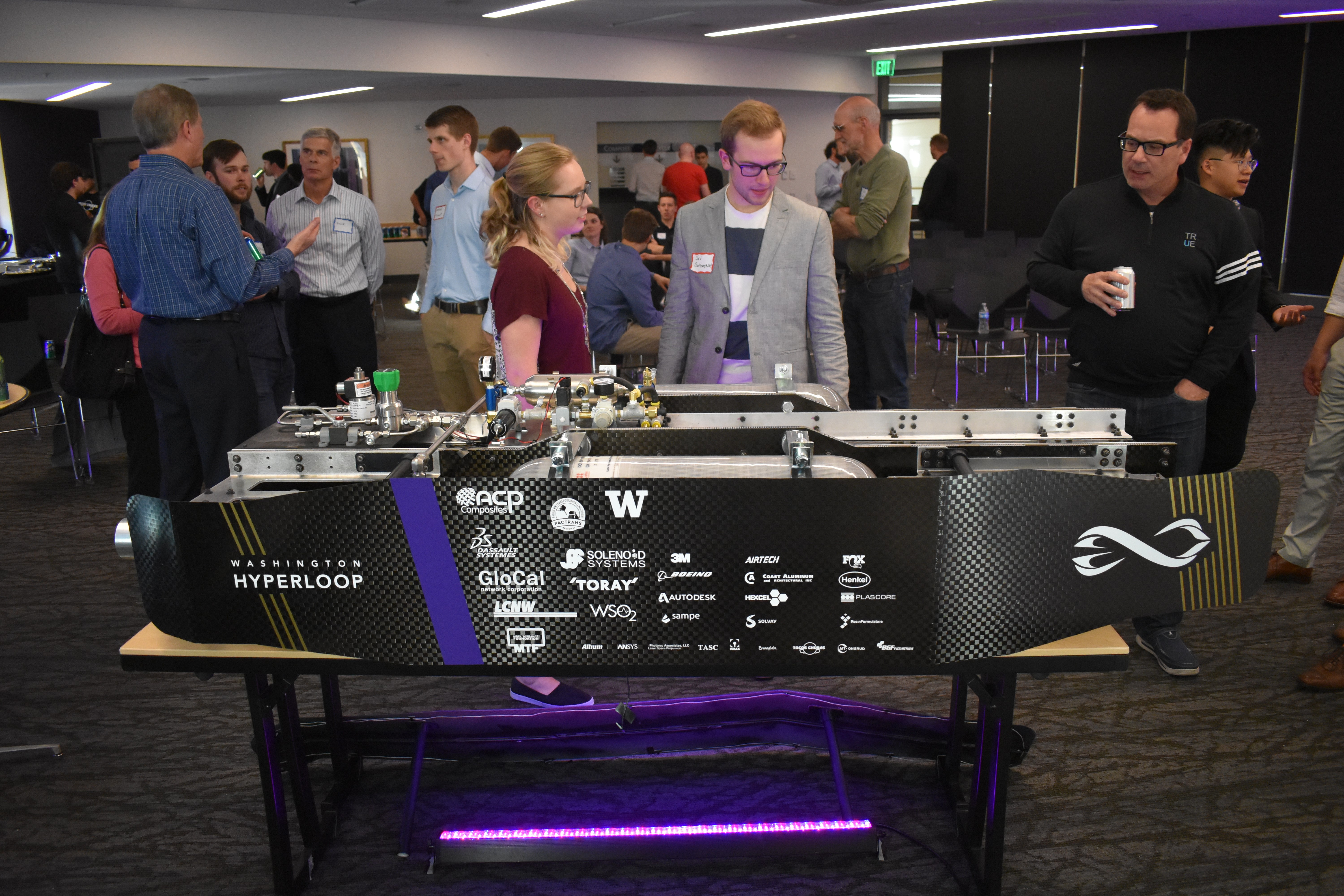
Washington Hyperloop unveils its next pod racer

Hyperloop pod racer
Courtney Klein, Washington Hyperloop team member Sev Sandomirsky and Marc Lemire take a look at the pod racer during its unveiling at the University of Washington. (GeekWire Photo / Alan Boyle)

The Washington Hyperloop team is counting on the third time being the charm.

But it’s not just a question of superstitious sayings: For SpaceX’s third university Hyperloop competition, the three dozen student engineers and entrepreneurs on the University of Washington’s pod-racing team have reworked the design for their vehicle from the ground up.

“Everything on this pod has been redesigned, manufactured,” said team co-leader Nicole Lambert, a junior who’s majoring in mechanical engineering. “It’s a completely new pod from the last two years.”

The pod racer had its formal unveiling at UW on June 1. It’ll be put to the ultimate test next month,  when SpaceX hosts a series of practice runs and races inside a mile-long enclosed test track next to the company’s headquarters in Hawthorne, Calif.

Get the full story on GeekWire.

Categories
GeekWire

Asteroid Institute launches its first research fellows

Asteroid tracks
The Asteroid Detection Analysis and Mapping software, or ADAM, can plot the courses of multiple asteroids, as shown in this visualization. (B612 Asteroid Institute via YouTube)

A Silicon Valley institute focusing on the perils and prospects posed by near-Earth objects has chosen its first senior research fellows to work at the University of Washington.

Bryce Bolin and Sarah Greenstreet will work under the direction of the Asteroid Institute’s executive director, Ed Lu, a former NASA astronaut and co-founder of the B612 Foundation.

“The team is growing,” Lu told GeekWire.

Like B612, the Asteroid Institute focuses on the issue of tracking and potentially deflecting asteroids that have a chance of hitting Earth. The institute puts its emphasis on research tools and technologies that can aid in planetary defense.

Lu said Bolin and Greenstreet will help with projects such as B612’s Asteroid Decision Analysis and Mapping project. ADAM has been compared to a Google Maps for solar system objects — which is an apt comparison, considering that Lu worked on Google Maps for a time after leaving NASA in 2007.

Get the full story on GeekWire.