A two-color composite image from the Gemini North Multi-Object Spectrograph in Hawaii shows the interstellar object 2I/Borisov. Blue and red dashes are images of background stars that appear to streak due to the comet’s motion. (Gemini Observatory / NSF / AURA Image / Travis Rector)
Two years after astronomers made their first detection of a celestial object that came into our solar system from the neighborhood of another star, they have now confirmed the existence of another one.
The comet, originally known as C/2019 Q4 (Borisov), was discovered on Aug. 30 by Gennady Borisov at the MARGO observatory in Crimea, a region that’s contested by Ukraine and Russia.
Based on an analysis of night-by-night observations, the International Astronomical Union announced today that the comet is “unambiguously interstellar in origin,” coming in from far beyond our solar system. The IAU also gave the object a new name to befit its interstellar status: 2I/Borisov.
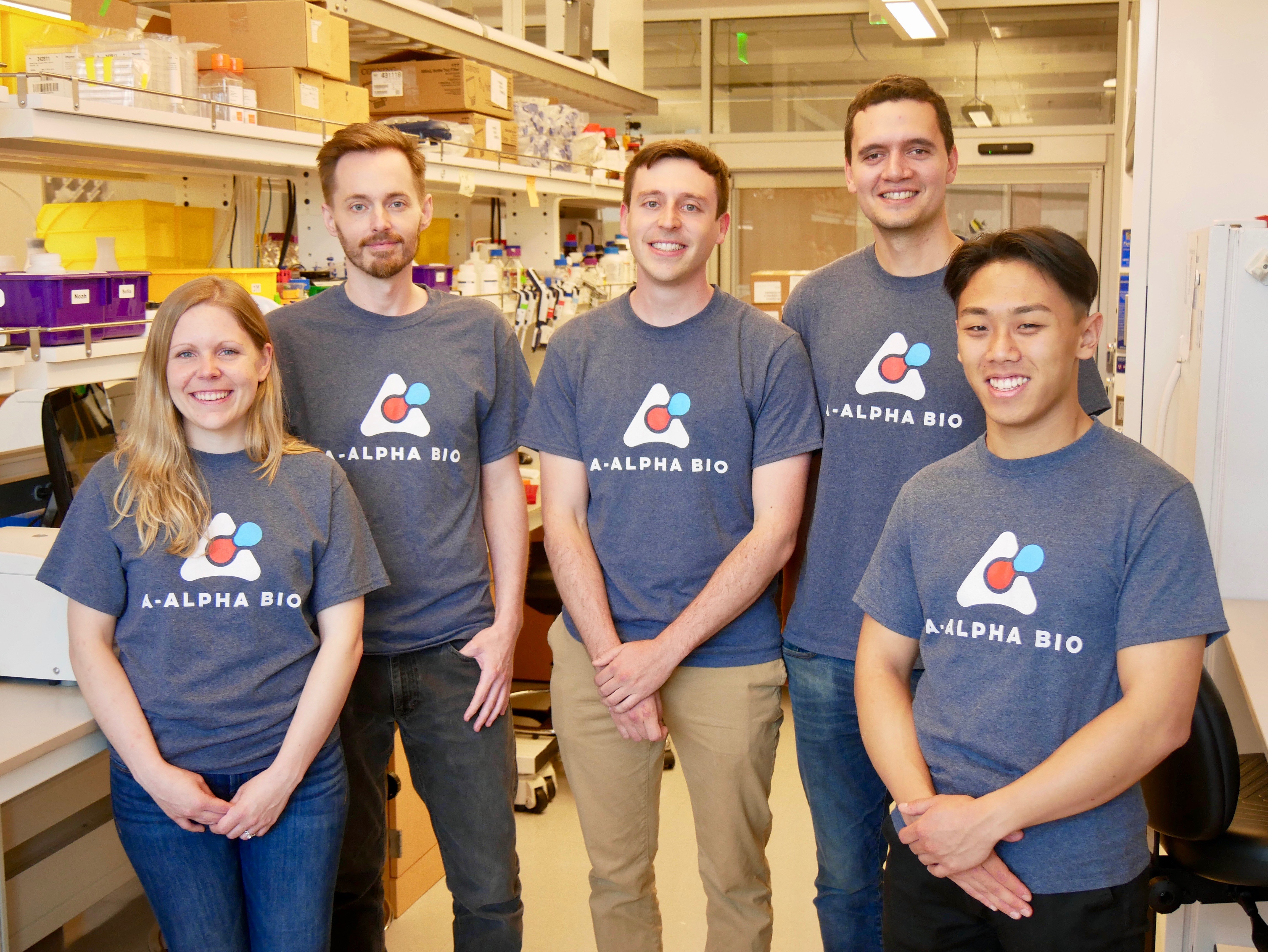
The A-Alpha Bio team includes scientist Emily Engelhart, principal scientist David Colby, co-founder and CEO David Younger, co-founder and chief technology officer Randolph Lopez and engineering associate Charles Lin. (A-Alpha Bio Photo)
A Seattle startup that took root at the University of Washington has closed a $2.8 million seed round for a drug discovery platform that can sort through millions of protein interactions at once.
“We expect that we can go considerably further than that,” said David Younger, the co-founder and CEO of A-Alpha Bio.
A-Alpha Bio’s genetically engineered protein analysis technology, known as AlphaSeq, has the potential to speed up the process of evaluating drug candidates. That’s what attracted interest from investors including OS Fund, which led the seed round, plus AME Cloud Ventures, Boom Capital, Madrona Venture Group, Sahsen Ventures, Washington Research Foundation and a number of angel investors.
The Orion crew capsule meant for NASA’s uncrewed Artemis 1 mission around the moon and back is being prepared for its flight. (NASA Photo / Radislav Sinyak)
NASA says it’s ordering three more Orion spacecraft for missions to the moon, at a cost of $2.7 billion — and plans to order as many as nine more by 2030.
Today’s announcement signals NASA’s long-term commitment to its Artemis program for lunar exploration and settlement, with a crewed lunar landing planned for as early as 2024.
The Orion spacecraft for that mission, known as Artemis 3, is included in the newly announced order, along with the spacecraft for Artemis 4 and 5.
The NEO Surveillance Mission’s space telescope would take advantage of technologies developed for NEOCam, the proposed spacecraft shown in this artist’s conception. (IPAC / Caltech Illustration)
The head of NASA’s science operations says the space agency intends to develop a new space-based infrared telescope to hunt down near-Earth objects — not primarily for science’s sake, but to ensure that potentially threatening space rocks are identified before they hit us.
NASA’s NEO Surveillance Mission will make use of technologies developed for a proposed telescope known as NEOCam, Thomas Zurbuchen, the agency’s associate administrator for science, said today during a meeting of NASA’s Planetary Science Advisory Committee in Washington, D.C.
NEOCam has long been considered as a candidate science mission under NASA’s Discovery Program. But today, Zurbuchen said the NEO Surveillance Mission would be recast as a planetary defense mission with NASA’s Jet Propulsion Laboratory playing the lead development role.
Seattle’s Museum of Flight may have put a Blue Angels jet on a pedestal, but today it rolled out the red carpet for a military aerobatic team of a different color: the Red Arrows of Britain’s Royal Air Force.
“They’re the best,” said Stephen Williams, a visitor from Horsham in southern England who was among the roughly 300 spectators and VIPs who turned out this morning to watch the Red Arrows arrive. “Your Blue Angels … they’re OK.”
Red wasn’t the only color in the Arrows’ quiver: As they made their photo-op rounds over downtown Seattle and Boeing Field, the pilots’ BAE Hawk T1 trainer jets released contrails of red, white and blue — the hues of the Union Jack as well as the Stars and Stripes.
Neuroscientist Christof Koch, president and chief scientific officer of the Allen Institute for Brain Science, talks about the roots of consciousness at the 2017 GeekWire Summit. (Photo by Dan DeLong for GeekWire)
Do animals possess consciousness? Can consciousness be uploaded into a computer? Can we measure objectively whether someone is conscious or not?
Those may sound like deep, imponderable questions — but in a newly published book, “The Feeling of Life Itself,” neuroscientist Christof Koch actually lays out some answers: Yes, no … and yes, scientists are already testing a method for measuring consciousness, with eerie implications.
Members of SpaceX’s team in Texas use cranes to add rear moving fins to the Starship Mk1 prototype. (Elon Musk via Twitter)
SpaceX CEO Elon Musk is talking up his Starship Mk1 prototype super-rocket in Texas, less than a week in advance of an eagerly awaited update on his plans for Starship trips to the moon, Mars and beyond.
Today’s sneak preview came in a flurry of tweets addressing some of the finer design points for Starship Mk1, which looks like a silvery silo equipped with rocket fins as it sits at SpaceX’s Boca Chica facility in South Texas. The 30-foot-wide, roughly 150-foot-tall prototype — and a similar Mk2 structure taking shape at SpaceX’s site in Florida — are meant to blaze a trail for an even bigger two-stage rocket, with the pointy-ended Starship sitting atop a Super Heavy first-stage booster.
During a live-streamed presentation that’s set for Sept. 28 at the Boca Chica site, Musk is expected to discuss plans for testing and flying the Starship system over the next few years.
An artist’s conception, released during the time when Intelsat was considering what would have been effectively a merger with OneWeb, shows a OneWeb satellite in orbit. (OneWeb Illustration)
One of the world’s biggest satellite operators, Intelsat, is accusing the OneWeb broadband satellite venture and its biggest investor, SoftBank, of breach of contract, fraud and conspiracy in a lawsuit seeking what could amount to tens or hundreds of millions of dollars in damages.
In the course of laying out its case, Intelsat told the New York State Supreme Court that it paid Redmond, Wash.-based Kymeta, a venture backed by Microsoft co-founder Bill Gates, $10 million for development of a flat-panel antenna for OneWeb’s constellation.
Intelsat’s Sept. 10 filing also said OneWeb has pivoted from its original plan to provide broadband access to underserved regions of the world to concentrate on the very markets that Intelsat was planning to serve under the terms of the deal it struck in 2015 with OneWeb: maritime and aviation mobility services, oil and gas industry services and government services.
The lawsuit claims that OneWeb decided to “abandon its business plan of focusing on consumer broadband, land-based connectivity and underserved geographic markets because OneWeb and/or SoftBank concluded such plan would not yield sufficient revenues and was not viable in the long term.”
Boeing’s MQ-25 Stingray drone successfully completed its first test flight today, marking a big step toward providing the Navy with robotic refuelers for carrier-based warplanes.
The test aircraft, known as T1, went through a two-hour autonomous flight that was conducted under the direction of Boeing test pilots at a ground control station at MidAmerica St. Louis Airport in Mascoutah, Ill., Boeing and the Navy reported in a news release.
Boeing said T1 completed an autonomous taxi and takeoff, and then flew a predetermined route to validate the aircraft’s basic flight functions and operations with the ground station.
The Allen Institute for Artificial Intelligence’s Supp.AI search engine combs through research focusing on interactions involving nutritional supplements as well as drugs. (GeekWire Photo / Alan Boyle
Physicians and regulators keep close tabs on how different drugs interact. But what about interactions involving dietary supplements?
“There’s just no way for anybody to keep up with the combinations of supplements and drugs,” said Deborah Rappaport, vice president of product at InHealth Medical Services. “It’s a huge number.”
Seattle’s Allen Institute for Artificial Intelligence, or AI2, is harnessing the power of its Semantic Scholar academic search engine to make the job easier. Today it unveiled Supp.AI, a searchable database that indexes 4,650 supplements and drugs from Abbokinase to Zytiga, and serves up research findings on more than 56,000 interactions involving those products.