Categories
GeekWire

X-37B space plane lands after 780 days in orbit

X-37B landing
The Air Force’s X-37B space plane lands at the Shuttle Landing Facility at NASA’s Kennedy Space Center. (Air Force Photo)

The U.S. Air Force’s X-37B space plane landed today after spending a record-setting 780 days in orbit testing hush-hush technologies for long-duration spaceflight.

Touchdown at the Shuttle Landing Facility at NASA’s Kennedy Space Center in Florida came at 3:51 a.m. ET (12:51 a.m. PT), the Air Force said in a statement. The landing marked the end of the fifth test mission for the uncrewed mini-space shuttle, which experts say appears to be part of an effort to develop more versatile, faster-acting and longer-running spacecraft for remote sensing and satellite deployment.

“The X-37B continues to demonstrate the importance of a reusable spaceplane,” Air Force Secretary Barbara Barrett said in today’s statement. “Each successive mission advances our nation’s space capabilities.”

Randy Walden, director of the Air Force Rapid Capabilities Office, said the X-37B “successfully completed all mission objectives.”
Get the full story on GeekWire.

Categories
GeekWire

Red Arrows fly aerobatics of a different color

Seattle’s Museum of Flight may have put a Blue Angels jet on a pedestal, but today it rolled out the red carpet for a military aerobatic team of a different color: the Red Arrows of Britain’s Royal Air Force.

“They’re the best,” said Stephen Williams, a visitor from Horsham in southern England who was among the roughly 300 spectators and VIPs who turned out this morning to watch the Red Arrows arrive. “Your Blue Angels … they’re OK.”

Red wasn’t the only color in the Arrows’ quiver: As they made their photo-op rounds over downtown Seattle and Boeing Field, the pilots’ BAE Hawk T1 trainer jets released contrails of red, white and blue — the hues of the Union Jack as well as the Stars and Stripes.

Today’s one-day stopover was mostly aimed at showing the colors and refueling the planes, between last weekend’s performance at the Oregon International Air Show in McMinnville and a series of events starting Sept. 24 in Vancouver, B.C., which is the next stop in the Red Arrows’ grueling two-month North America tour.

Get the full story on GeekWire.

Categories
GeekWire

Boeing’s robotic refueling drone aces test flight

Boeing’s MQ-25 Stingray drone successfully completed its first test flight today, marking a big step toward providing the Navy with robotic refuelers for carrier-based warplanes.

The test aircraft, known as T1, went through a two-hour autonomous flight that was conducted under the direction of Boeing test pilots at a ground control station at MidAmerica St. Louis Airport in Mascoutah, Ill., Boeing and the Navy reported in a news release.

Boeing said T1 completed an autonomous taxi and takeoff, and then flew a predetermined route to validate the aircraft’s basic flight functions and operations with the ground station.

Get the full story on GeekWire.

Categories
GeekWire

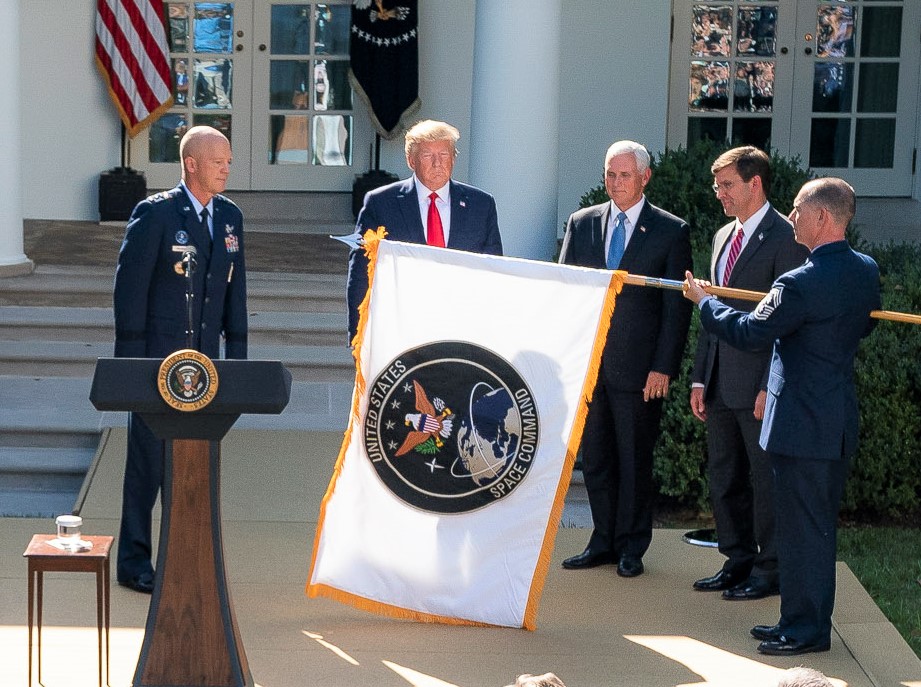
Trump kicks off Space Command; Space Force next?

Space Command ceremony
The official flag of the newly revived U.S. Space Command is unfurled at a White House Rose Garden ceremony, with Air Force Gen. Jay Raymond, President Donald Trump, Vice President Mike Pence and Defense Secretary Mark Esper looking on. (White House Photo / Tia Dufour)

President Donald Trump today hailed the revival of the U.S. Space Command to protect America’s technological assets on the final frontier, and put in another pitch for the establishment of a U.S. Space Force as the sixth branch of the armed forces.

“This is a landmark day — one that recognizes the centrality of space to America’s national security and defense,” the president said.

“As the newest combatant command, SPACECOM will defend America’s vital interests in space — the next warfighting domain. And I think that’s pretty obvious to everybody. It’s all about space,” Trump declared during a White House Rose Garden ceremony that was also attended by Vice President Mike Pence, Defense Secretary Mark Esper and other officials.

“This is a landmark day — one that recognizes the centrality of space to America’s national security and defense,” the president said.

After Trump spoke, Esper signed the documents establishing the Space Command.

Get the full story on GeekWire.

Categories
GeekWire

Tech titans face scrutiny over killer-robot tech

SpotMini and Marc Raibert
Boston Dynamics’ four-legged SpotMini robot may look scary as it shares the stage with company founder and CEO Marc Raibert at Amazon’s re:MARS conference in Las Vegas in June. But a report published this month praises Boston Dynamics’ owner, SoftBank, for confirming that it won’t develop technologies that could be used for military purposes. (GeekWire Photo / Alan Boyle)

Dutch activists are voicing concerns about technologies that could open the way for lethal autonomous weapons – such as AI software, facial recognition and swarming aerial systems – and are wondering where several tech titans including Amazon and Microsoft stand.

So are some AI researchers in the United States.

report issued by Pax, a Dutch group that’s part of an international initiative known as the Campaign to Stop Killer Robots, calls out Amazon, Microsoft and other companies for not responding to the group’s inquiries about their activities and policies in the context of lethal autonomous weapons.

“Why are companies like Microsoft and Amazon not denying that they’re currently developing these highly controversial weapons, which could decide to kill people without direct human involvement?” the report’s lead author, Frank Slijper, said this week in a news release. “Many experts warn that they would violate fundamental legal and ethical principles and would be a destabilizing threat to international peace and security.”

Get the full story on GeekWire.

Categories
GeekWire

Blue Origin protests launch contract rules

New Glenn rocket
An artist’s conception shows Blue Origin’s future New Glenn rocket, which is currently due to have its first flight in 2021. (Blue Origin Illustration)

Amazon billionaire Jeff Bezos’ Blue Origin space venture is protesting the rules of the game for awarding future national security launch contracts, while continuing to play against SpaceX, United Launch Alliance and Northrop Grumman.

All four companies have submitted bids in the second phase of an Air Force competition aimed at selecting vendors for launches in the 2022-2026 time frame.

In the first phase of the competition, the Air Force said it would set aside as much as $2.3 billion to support the development of Blue Origin’s New Glenn rocket, ULA’s Vulcan rocket and Northrop Grumman’s OmegA rocket. All those rockets are scheduled to enter service in the 2021 time frame.

However, the Air Force said it would reduce the field to two companies next year. Moreover, SpaceX – which didn’t qualify for development funds in Phase 1 – is joining the field for Phase 2 with its Falcon 9 and Falcon Heavy rockets, both of which are already flying.

In May, SpaceX filed a lawsuit against the federal government, complaining that it was unfairly left out of the Phase 1 awards and left at a disadvantage for Phase 2. Back then, the other three companies disputed SpaceX’s claims and supported the Air Force’s Phase 1 arrangement.

Today, it was Blue Origin’s turn to protest: The company said it filed a pre-award bid protest with the Government Accountability Office, claiming that it would be unfair for the Air Force to reduce the field to just two companies.

Get the full story on GeekWire.

Categories
GeekWire

Shipwreck-hunting project wins TV spotlight

Vulcan's Rob Kraft
Rob Kraft is Vulcan’s director of subsea operations. (Image © 2019 Navigea Ltd. / R/V Petrel)

The voyages of the R/V Petrel, funded by the late Seattle billionaire Paul Allen, are the focus of a National Geographic documentary premiering on Aug. 12 – and as a prelude to the show, the leader of the Petrel team is talking about what it takes to find historic shipwrecks in the Pacific.

“Our missions have led to discovery of over 30 historically significant shipwrecks, diverse ecosystems and encounters with rare marine species,” Rob Kraft, Vulcan’s director of subsea operations, says in an online Q&A. “The environment we operate in brings inherent dangers, challenges and risk that most people will never experience.”

That all sounds like a natural fit for the next episode of “Drain the Oceans,” a National Geographic series that delves into what we’d find beneath the waves if the world’s oceans could magically disappear.

Get the full story on GeekWire.

Categories
GeekWire

Former Boeing exec is out as acting Pentagon chief

Patrick Shanahan
Acting Defense Secretary Patrick Shanahan speaks at an event presented by the Center for Strategic and International Studies. (Department of Defense Photo)

President Donald Trump announced in a tweet that former Boeing executive Patrick Shanahan is leaving his post as acting defense secretary, hours after reports about a 1990 domestic dispute involving Shanahan and his ex-wife came to light.

Trump didn’t refer to those reports. He said Shanahan would not be going through with the Senate confirmation process to take on the top Pentagon post permanently, but would instead “devote more time with his family.”

Army Secretary Mark Esper will be named acting defense secretary in Shanahan’s stead, Trump tweeted.

Get the full story on GeekWire.

Categories
GeekWire

Filings reveal details of SpaceX rocket lawsuit

BE-4 engine test
Blue Origin’s BE-4 rocket engine, shown here during a test firing in Texas, is being developed for use on Blue Origin’s New Glenn rocket as well as United Launch Alliance’s Vulcan rocket. (Blue Origin Photo)

Amazon billionaire Jeff Bezos’ Blue Origin space venture and subsidiaries of United Launch Alliance and Northrop Grumman are intervening in a SpaceX lawsuit protesting $2.3 billion in rocket development awards to those three companies.

In a redacted version of the lawsuit, originally filed on May 17 and made public today, SpaceX says it was unfairly passed over when the awards were made last October — and disparages the three companies’ rocket projects.

Get the full story on GeekWire.

Categories
GeekWire

Rocket Lab launches three U.S. military satellites

Rocket Lab launch
Rocket Lab’s Electron launch vehicle lifts off from its New Zealand pad. (Rocket Lab via YouTube)

Rocket Lab sent a trio of research satellites for the U.S. military into orbit tonight from a launch pad that’s thousands of miles from America’s shores, in New Zealand.

The Los Angeles-based company’s low-cost Electron rocket lifted off from its seaside launch facility on New Zealand’s Mahia Peninsula at 6 p.m. May 5 local time (11 p.m. PT May 4). It was Rocket Lab’s second launch of 2019, and its sixth mission overall.

After liftoff, the Electron’s second stage separated from the first-stage booster, and then released its “kick stage” to deploy the satellites in orbit.

“Perfect flight, complete mission success, all payloads deployed!!” Rocket Lab founder and CEO Peter Beck tweeted.

Get the full story on GeekWire.