Pluto is all smiles in NASA’s valentine. (Credit: NASA)
Say it with Pluto? After NASA’s New Horizons spacecraft spotted a heart-shaped region on Pluto, you had to know it was just a matter of time before the dwarf planet made its appearance on a valentine.
Sure enough, this year’s crop of printable Valentine’s Day cards from NASA’s educational Space Place website includes a stylized Pluto.
An artist’s conception shows Lunar Flashlight flying above a crater on the moon. (Credit: NASA)
NASA says it’ll send 13 miniaturized satellites – including a pop-up solar sail and a “lunar flashlight” – beyond Earth orbit when it flies its heavy-lift Space Launch System rocket for the first time in 2018.
The main payload for the test flight, known as Exploration Mission-1 or EM-1, is an uncrewed prototype for NASA’s Orion spaceship. The SLS will send Orion into a highly eccentric orbit that ranges beyond the moon and back.
But there’s also room inside the rocket’s adapter ring for a baker’s dozen of CubeSats, boxy spacecraft of a standard size that are becoming increasingly popular for low-cost space missions.
“They’re really on the cutting edge of technology,” NASA Deputy Administrator Dava Newman said today during a news conference at NASA’s Marshall Space Flight Center in Alabama.
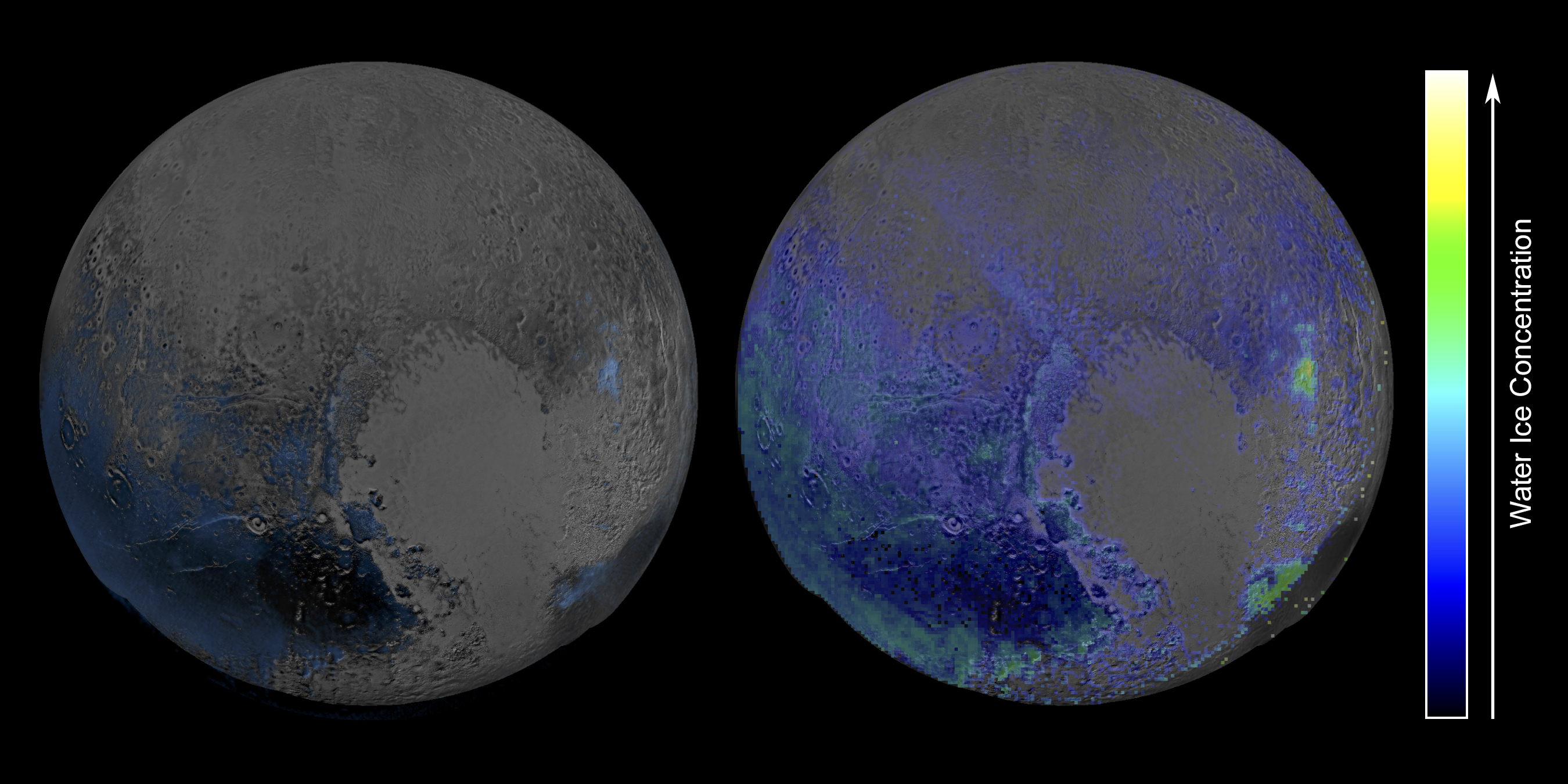
This false-color infrared image from NASA’s New Horizons spacecraft shows water ice concentrations on Pluto. The left image is the result of an initial analysis, and the right image has been reprocessed to account for mixtures with other types of ice. (Credit: NASA / JHUAPL / SwRI)
A color-coded map from NASA’s New Horizons mission shows where Pluto’s frozen water is concentrated, just in case we need to fill up our tanks on the way toAlpha Centauri or Planet Nine.
Water ice turns out to be more widespread on the dwarf planet than previously thought, the mission’s researchers reported today. They came to that conclusion after some sophisticated analysis of infrared imagery captured during the New Horizons spacecraft’s flyby last July 14.
Soon after the flyby, the mission team concluded that Pluto possessed mountains of water ice rising as high as 11,000 feet above the icy world’s surface. That conclusion was confirmed in follow-up studies based on the infrared data from the piano-sized probe’s Ralph/LEISA instrument.
LEISA’s survey mapped concentrations of water ice, but scientists figured out that the spectral readings could be thrown off if the frozen water was mixed in with frozen methane. When they modeled the contributions from other types of ice on Pluto’s surface, the resulting map showed wider stretches where water ice should be present.
Technicians at an SNC facility in Colorado inspect the Dream Chaser engineering test article, or ETA, which is being put through flight tests. (Credit: Sierra Nevada Corporation)
NASA’s decision to use Sierra Nevada Corporation’s Dream Chaser mini-shuttle to carry cargo to and from the International Space Station marks the most positive development to date for a space program that’s been a decade in the making. But the head of that program says it’s only the beginning.
“We’re getting more interest in the last couple of weeks than we’ve had before,” Mark Sirangelo, SNC’s corporate vice president of space systems, told GeekWire on Monday.
The privately held Nevada-based company mostly flies under the radar, even though it’s a significant military contractor. But thanks to the cargo contract announced this month, SNC’s Colorado-based space systems operation is likely to get a brighter spotlight – as well as additional work for the Dream Chaser.
NASA’s Tim Kopra works outside the International Space Station. Kopra and British crewmate Tim Peake had to end their spacewalk early due to water in Kopra’s helmet. (Credit: NASA TV)
Friday’s spacewalk at the International Space Station was called off early when NASA astronaut Tim Kopra reported a small bubble of water inside his spacesuit helmet.
NASA commentator Rob Navias said the crew “was never in any danger at all.” Kopra and his fellow spacewalker, Britain’s Tim Peake, got back inside the station safely. Nevertheless, the incident echoed a scary episode in 2013 when Italian astronaut Luca Parmitano nearly drowned inside his spacesuit. That forced a months-long investigation as well as the addition of absorbent pads and snorkels inside the U.S.-made suits.
The earlier water leak was traced to contamination that blocked up a water separator in the suit’s air-circulation system. A pool of water crept up into the helmet in zero-G and began to cover Parmitano’s face.
Things never got that far in Friday’s incident. As soon as Kopra reported moisture in the helmet, NASA went into a procedure to stop work, bring the astronauts back inside and get their suits off.
An artist’s conception shows Sierra Nevada’s uncrewed version of the Dream Chaser space glider in orbit with a cargo module attached at the back. (Credit: Sierra Nevada Corp.)
NASA says it will add Sierra Nevada Corp.’s Dream Chaser space glider to its cargo-carrying lineup of robotic spaceships as early as 2019. It’s likely to be the first winged vehicle to fly in orbit for NASA since the space shuttle fleet’s retirement in 2011.
“Within a few short years, the world will once again see a United States winged vehicle launch and return from space to a runway landing,” Mark Sirangelo, corporate vice president of Sierra Nevada Corp. Space Systems, said in a statement about the Dream Chaser’s selection.
During a televised briefing today, NASA officials said it also will continue to use SpaceX’s Dragon and Orbital ATK’s Cygnus capsules to resupply the International Space Station in the 2019-2024 time frame. By that time, the Dragon could well be capable of touching down on land.
The upgrades in SpaceX’s robotic Dragon, along with the addition of the Dream Chaser, are expected to bring new capabilities to NASA’s orbital delivery system.
This image of Ceres’ Kupalo Crater was captured by NASA’s Dawn spacecraft from a height of about 240 miles on Dec. 21. (Credit: NASA / JPL-Caltech / UCLA / MPS / DLR / IDA)
For years, scientists puzzled over the bright spots that shine like alien headlights from the surface of Ceres, a dwarf planet in the main asteroid belt. Scientists are leaning toward identifying them as salt deposits, and now there’s a new line of evidence that could help tell the tale definitively.
The evidence takes the form of bright deposits in Kupalo Crater, one of the freshest craters spotted on Ceres. In this case, just a little bit of bright material can be seen on on the crater’s floor. But lots of the stuff is tumbling down from the crater’s rim.
The material shows up clearly in an image captured by NASA’s Dawn spacecraft. Dawn has been circling Ceres since last March, but last month it descended to a 240-mile orbit for up-close imaging. The newly released picture of Kupalo Crater was taken Dec. 21.
“This crater and its recently formed deposits will be a prime target of study for the team as Dawn continues to explore Ceres in its final mapping phase,” Paul Schenk, a Dawn science team member at the Lunar and Planetary Institute in Houston, said Tuesday in a NASA news release.
Fox’s “Life in Space” series is aimed at stirring up interest in today’s release of “The Martian” on DVD and Blu-ray. And speaking of “stirring,” one of the key issues on the International Space Station has to do with getting sufficient shut-eye without floating into your crewmate’s bunk.
NASA astronaut Drew Feustel, a veteran of two space shuttle flights, handles the question in a 46-second clip. It turns out that the accommodations are cozier than you might think.
This image from NASA’s New Horizons spacecraft shows patterns in the nitrogen glaciers of an area nicknamed Sputnik Planum – including an “X” to the right and below the image’s center. The darker patch at the center of the image is probably a dirty block of water ice “floating” in the denser nitrogen. (Credit: NASA / JHUAPL / SwRI)
If “X-Files” are defined as data about weird and alien phenomena, NASA’s New Horizons mission to Pluto has X-Files galore. And this week, the mission’s science team shared an X-File with an actual X on it.
The timing of Thursday’s image release couldn’t be much better, coming just a couple of weeks before “The X-Files” (the TV show, that is) returns to Fox for a six-episode run. But this is no publicity stunt; rather, it illustrates how weird geology can get on a world that features glaciers of frozen nitrogen.
The semi-solid nitrogen in a region informally known as Sputnik Planum slowly burbles up and down, due to thermal convection. When blobs of nitrogen rise up and press against each other, patterns of lines mark the boundaries between the blobs. When the blobs subside, the lines disappear.
“This part of Pluto is acting like a lava lamp, if you can imagine a lava lamp as wide as, and even deeper than, the Hudson Bay,” William McKinnon, a researcher from Washington University in St. Louis who’s the deputy lead of the New Horizons geology, geophysics and imaging team, said in a NASA feature.
NASA astronaut Anne McClain keeps her eye on the Magic 8 Ball during zero-G training on NASA’s “vomit comet” airplane in 2014. The toy served as a mascot for the eight astronauts in the class of 2013, who were nicknamed the “8 Balls.” (Credit: NASA via @AstroAnnimal)
That’s one small step for NASA’s women astronauts, one giant leap for Glamour magazine.
Women have had a hard time getting their just deserts when it comes to human spaceflight: The “Mercury 13” were passed over in the early 1960s, and that was just the start. In 2005, a top Russian space medicine official said women were too weak to take on a trip to Mars. Just in the past year and a half, women astronauts have had to fend off questions about hair styling and makeup.