Categories
GeekWire

How will Elon Musk get colonists to Mars?

Image: Mars Colonial Transporter
An animation shows a lander separating from the rest of the Mars Colonial Transporter. Later concepts suggest that the entire MCT would land as a unit. (Credit: Michel Lamontagne / ESA via YouTube)

In the wake of SpaceX’s successful rocket landing, some of the company’s most ardent fans are guessing at the shape of the biggest thing to come: the Mars Colonial Transporter.

The MCT is a crucial piece in SpaceX founder Elon Musk’s grand plan to send tens of thousands of colonists to the Red Planet, potentially starting in the next decade or two. Such a venture would mark a giant leap toward establishing a second cosmic home for humanity. Musk believes that’s a must if we’re to guard against extinction due to pandemics, asteroid strikes or other planet-wide catastrophes.

Early this year, Musk promised to unveil his architecture for Mars colonization by the end of 2015 – but in a recent GQ interview, he said the big reveal was more likely to come in early 2016. “Before we announce it, I want to make sure that we’re not gonna make really big changes to it,” he said.

Despite Musk’s reticence, space geeks have been chewing over the elements of a potential plan for years, based on the hints that have been dropped to date.

Get the full story on GeekWire.

Categories
GeekWire

SpaceX’s rocket landing caught on video

Image: SpaceX rocket landing
paceX’s Falcon 9 rocket descends to a touchdown at Landing Zone 1. (Credit: SpaceX)

A day after the first-ever fully successful landing of a SpaceX Falcon 9 booster, space fans around the world are geeking out over the pictures. And it’s not just geeks.

Brig. Gen. Wayne Monteith, commander of the U.S. Air Force’s 45th Space Wing, said the Florida landing “clearly placed the exclamation mark on 2015, by closing out another successful year for the Eastern Range in historic fashion.”

The two-stage Falcon 9 rocket was launched on Monday night from Cape Canaveral Air Force Station, successfully sending 11 communication satellites into orbit for Orbcomm.

That would have been significant enough, coming nearly six months after a Falcon launch failure forced SpaceX to hold up on its space missions. But the first-stage booster’s return to a converted missile range, now dubbed Landing Zone 1, marked the first time that a rocket returned safely to ground after launching an orbital mission.

The Blue Origin space venture demonstrated a similar rocket return during asuborbital test mission last month, but SpaceX’s feat carries even bigger implications for lowering the cost of access to orbit. Bottom line? The pace of the commercial space race is heating up – so enjoy the show on SpaceX’s Flickr site and YouTube channel,

Check out the pictures and video on GeekWire.

Categories
GeekWire

SpaceX launches Falcon 9 rocket – and lands it!

Image: SpaceX Falcon 9 landing
The Falcon 9 rocket’s first-stage booster sets down at SpaceX’s Landing Zone 1. (Credit: SpaceX)

SpaceX launched its Falcon 9 rocket for the first time in six months today, and then brought he first-stage booster back down for a first-ever Florida landing.

“The Falcon has landed!” SpaceX’s launch commentator announced.

Hundreds of SpaceX employees cheered the touchdown at the company’s headquarters in Hawthorne, Calif. “USA! USA! USA!” they chanted.

The flight’s main objective was to send 11 satellites into low Earth orbit to boost Orbcom’s OG2 network for machine-to-machine communications. The landing attempt was a bonus, aimed at furthering SpaceX’s goal of bringing down the cost of spaceflight dramatically.

Get the full story on GeekWire.

Categories
GeekWire

SpaceX delays launch to lift odds for landing

Image: Falcon rocket on pad
SpaceX’s Falcon 9 rocket stands on its Florida launch pad. (Credit: Orbcomm)

SpaceX has delayed the launch of its Falcon 9 rocket with 11 Orbcomm telecommunication satellites for a day, to wait for a better chance to land the rocket’s first-stage booster after liftoff.

The commercial rocket company’s billionaire founder, Elon Musk, said the decision to put off Sunday’s scheduled launch attempt was made after a review of the mission parameters. In a tweet, he said an analysis of probabilistic Monte Carlo simulations showed there was a “10 percent higher chance of a good landing” on Monday night.

As a result, the countdown was delayed 24 hours. Liftoff from Cape Canaveral Air Force Station in Florida is now scheduled for 8:33 p.m. ET (5:33 p.m. PT) Monday. Forecasters said there was an 80 percent chance of favorable weather conditions for launch.

Get the full story on GeekWire.

Categories
GeekWire

Good news for Boeing’s space taxi – and SpaceX

Image: Boeing CST-100 Starliner
An artist’s conception shows Boeing’s CST-100 Starliner at the International Space Station. (Credit: NASA)

NASA has ordered a second space taxi from the Boeing Co. to carry astronauts to the International Space Station a couple of years from now.

Boeing’s CST-100 Starliner capsule and an upgraded version of SpaceX’s Dragon spacecraft won’t go into service until 2017 at the earliest, but NASA has to put in its orders well in advance to get the ball rolling. NASA has been providing billions of dollars to support the commercial spaceship development effort.

“Once certified by NASA, the Boeing CST-100 Starliner and SpaceX Crew Dragon each will be capable of two crew launches to the station per year,” Kathy Lueders, manager of NASA’s Commercial Crew Program, said today in a news release. “Placing orders for those missions now really sets us up for a sustainable future aboard the International Space Station.”

Get the full story on Boeing’s order and SpaceX’s launch test.

Categories
GeekWire

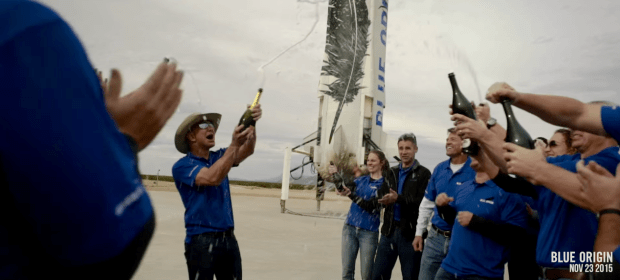
Jeff Bezos spaces out: ‘I can’t wait to go!’

Image: Jeff Bezos and champagne
Jeff Bezos, the founder of Amazon and Blue Origin, sprays champagne from a bottle after the successful landing of the New Shepard rocket booster on Monday. (Credit: Blue Origin via YouTube)

Amazon’s billionaire founder, Jeff Bezos, says watching his Blue Origin rocket make a safe landing after flying into space rates as one of the greatest moments of his life, and he can’t wait to take a ride himself.

In an exclusive GeekWire interview, conducted on the morning after the New Shepard test mission, Bezos answered questions about what the flight means for Blue Origin, the space venture he founded … why he waited so long to start tweeting … and when the rest of us will get a suborbital space ride. He also stirred the pot in his rivalry with that other billionaire space geek, SpaceX founder Elon Musk.

Get the full Q&A on GeekWire.

Categories
GeekWire

Amazon’s Jeff Bezos tweets for the first time

The flight of Blue Origin’s New Shepard rocket ship on an uncrewed trip to space and back may be history-making, but here’s a first that’s almost as big for social media: Jeff Bezos’ maiden tweet.

One of Bezos’ biggest rivals in the space game is SpaceX’s billionaire founder, Elon Musk, who weighed in with an artful series of tweets that started out praising Blue Origin’s test flight but ended up downplaying it.

Get the full story on GeekWire.

Categories
GeekWire

NASA hails SpaceX’s taxi for future crew

SpaceX Crew Dragon
An artist’s conception shows SpaceX’s Crew Dragon capsule en route to the International Space Station. (Credit: SpaceX)

NASA has ordered its first mission from SpaceX to carry astronauts to the International Space Station, six months after placing a similar order with Boeing.

“It’s really exciting to see SpaceX and Boeing with hardware in flow for their first crew rotation missions,” Kathy Lueders, manager of NASA’s Commercial Crew Program, said today in a news release. “It is important to have at least two healthy and robust capabilities from U.S. companies to deliver crew and critical scientific experiments from American soil to the space station throughout its lifespan.”

Both companies are developing space taxis for NASA’s use as early as 2017, under the terms of multibillion-dollar contracts that were awarded last year.

Even though the first order went to Boeing, it has not yet been determined whether Boeing’s CST-100 Starliner capsule or SpaceX’s Crew Dragon capsule will go first. The contracts required NASA to put in its orders early, but the scheduling decisions and required certifications will be made at a later time.

Get the full story on GeekWire.

Categories
GeekWire

Elon Musk gets in the Thanksgiving spirit on TV

You wouldn’t think Elon Musk was a warm and fuzzy guy, based on this year’s biography of the hard-driving CEO of SpaceX and Tesla Motors, but on this week’s episode of “The Big Bang Theory,” we learn that he loves to help the homeless.

The big reveal comes when engineer and one-time spaceflier Howard Wolowitz (played by Simon Helberg) reluctantly joins his wife as well as his pal Raj and his girlfriend to help with Thanksgiving dinner at a homeless shelter. Howard gets stuck washing the dishes, but loses control of his sink sprayer when he sees Musk walk in with a load of dirty plates.

“What are you doing here?!” Howard asks.

“I’m washing dishes … I was on the turkey line, but I got demoted for being too generous with the gravy,” Musk replies.

Get the full story on GeekWire.

Categories
GeekWire

SpaceX leads in launch competition, by default

SpaceX Falcon 9 launch
A SpaceX Falcon 9 rocket launches the DSCOVR satellite in February. (Credit: SpaceX)

SpaceX is poised to win an Air Force national security launch contract by default because its archrival, United Launch Alliance, has dropped out of the competition.

ULA said this week that it decided not to bid on the Air Force contract for launching a GPS-3 satellite in 2018, leaving SpaceX as the sole bidder. The contract was the first of its kind to come up since the Air Force certified SpaceX’s Falcon 9 rocket to launch national security payloads.

Reuters quoted ULA’s chief executive officer, Tory Bruno, as saying that the Boeing-Lockheed Martin joint venture couldn’t submit a compliant bid because of a federally mandated ban on the use of Russian-built RD-180 engines for national security launches. ULA uses the RD-180s on the first stage of its Atlas 5 rocket, which has traditionally been used for such launches. A defense authorization bill currently under consideration in Congress includes a provision that would give ULA access to four more of the engines, but that bill has not yet been signed into law.

Bruno also told Reuters that the criteria for bid selection don’t give ULA enough credit for its record of reliability and schedule certainty, and that the accounting procedures for separating the funds for GPS-3 from other government contracts were too onerous.

Monday was the deadline for submitting a bid for the GPS-3 launch. SpaceX declined to comment on the prospects for the contract, which is thought to be worth in the neighborhood of $70 million to $80 million.

Get the full story on GeekWire.