Categories
GeekWire

Rocket Lab celebrates coming close to orbit

Rocket Lab Peter Beck celebrates
Rocket Lab CEO Peter Beck cheers the first Electron rocket launch. (Rocket Lab via YouTube)

Rocket Lab didn’t quite make it to orbit on its first try, but the company’s CEO says he’s “very happy” with the Electron rocket’s performance nevertheless.

“We got a lot further than certainly we expected,” founder and CEO Peter Beck told reporters today, hours after the maiden launch from Rocket Lab’s pad on New Zealand’s Mahia Peninsula.

Beck repeatedly stressed that the company still has to analyze the data from the flight. However, he said a preliminary review indicated that the two-stage rocket’s performance was nominal until second-stage fairing separation.

He told GeekWire that the launch team had targeted a 300- to 500-kilometer orbit (200 to 300 miles) for its first test flight, nicknamed “It’s a Test.” Beck estimated that the second stage made it to a height of 250 kilometers (155 miles) before descending again on a suborbital trajectory.

Today Rocket Lab released a video of the countdown and launch that had a decidedly celebratory feel, highlighting the cheers in Mission Control when the rocket rose spaceward.

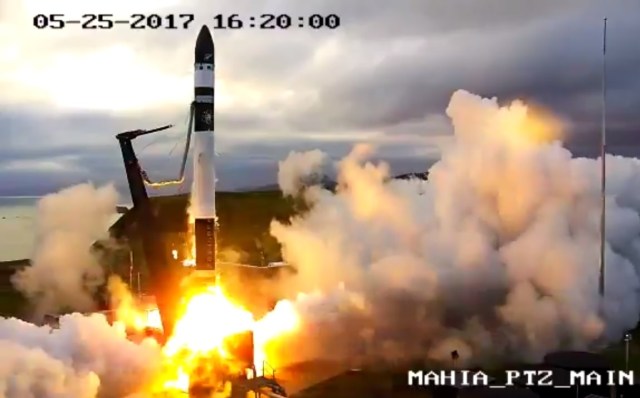
Get the full story on GeekWire.

Categories
GeekWire

Here’s how NASA’s Mars 2020 rover will look

Mars 2020 rover
This artist’s concept depicts NASA’s Mars 2020 rover on the surface of Mars. (NASA / JPL-Caltech)

The rover that NASA is getting ready to send to Mars in 2020 looks a lot like the Curiosity rover that’s been working on Mars for almost five years – except for that freakishly big robotic arm.

The arm is one of the keys to the rover’s more ambitious mission: to turn up potential traces left behind by ancient life on the Red Planet, and to tuck away samples for eventual return to Earth.

The six-wheeled robot, built on the same type of chassis used for Curiosity, is due for launch in the summer of 2020 toward one of three sites: Northeast Syrtis Major, Jezero Crater or Columbia Hills.

NASA probably won’t decide which site to target for another year or two, but in the meantime, NASA’s Jet Propulsion Laboratory put out a new artist’s concept showing the 2020 rover at a Martian work site. The site shown in the picture actually looks a lot like Curiosity’s stomping grounds in Gale Crater.

Get the full story on GeekWire.

Categories
GeekWire

Rocket Lab’s first test flight reaches space

Rocket Lab Electron launch
Rocket Lab’s Electron rocket rises from its New Zealand launch pad. (Rocket Lab via Twitter)

Rocket Lab says its first Electron rocket “made it to space” after a test launch from a New Zealand pad, marking a big step toward its goal of putting payloads into orbit for $5 million.

Liftoff came at 4:20 p.m. May 25 New Zealand time (9:20 p.m. PT May 24), after earlier opportunities had to be passed up due to weather concerns.

In a statement, Rocket Lab founder and CEO Peter Beck said the rocket achieved an outer-space altitude but fell short of going orbital.

Get the full story on GeekWire.

Categories
GeekWire

Boeing wins DARPA’s nod for space plane

Phanton Express XS-1 space plane
An artist’s conception shows Boeing’s Phantom Express XS-1 space plane in flight. (Boeing Illustration)

The Pentagon’s Defense Advanced Research Projects Agency says it has selected the Boeing Co. to develop and test its XS-1 hypersonic space plane, using a design now known as the Phantom Express.

Boeing won out over Northrop Grumman and Masten Space Systems to take the long-running XS-1 project beyond Phase 1 into Phase 2/3, culminating with test flights in 2020.

The reusable space plane would be designed to carry and deploy a small, expendable upper stage, then return to Earth for a runway landing. The upper stage would be capable of putting satellites weighing up to 3,000 pounds in low Earth orbit.

Get the full story on GeekWire.

Categories
GeekWire

Can faux meat produce meaty profits?

Josh Balk and cookies
Josh Balk, a co-founder of Hampton Creek Foods, grins over a spread of cookies made with Hampton Creek’s vegan cookie dough. (GeekWire Photo / Alan Boyle)

Is there money to be made by going meatless? Substitutes for meat, dairy and eggs have been around for decades, as demonstrated by the success of Seattle-based Field Roast Grain Meat Co., but new technologies may well give what’s now known as “clean meat” a boost.

“I don’t know of any companies that are true innovators in this space that are flailing,” said Chris Kerr, investment manager at New Crop Capital, a D.C.-based venture capital firm that specializes in the food frontier.

Kerr was among the experts speaking at a survey of the marketplace for clean meat – that is, meat products that are essentially grown from cells in a vat rather than animals in a feedlot – as well as for plant-based proteins like Field Roast. The May 22 presentation was organized by the University of Washington’s CoMotion Labs in collaboration with the Good Food Institute, a clean-meat advocacy group.

Get the full story on GeekWire.

Categories
GeekWire

NASA spacewalkers triumph over fussy bolt

NASA astronaut Jack Fischer waves to the camera during a repair spacewalk. (NASA TV)

NASA spacewalkers Peggy Whitson and Jack Fischer replaced a faulty computer relay box on the International Space Station today, but not before dealing with a problem all too familiar to home fixer-uppers.

The box, about the size of a microwave oven, is known as a multiplexer-demultiplexer or MDM. It’s one of two MDMs that regulate the operation of the station’s radiators, solar arrays and cooling loops. The component failed on May 20, but because each box can handle all essential functions, operations on the station weren’t affected.

NASA decided to go ahead with a rapid-response spacewalk today to preserve the system’s redundancy, and Whitson made quick work of uninstalling the failed equipment. However, when it came time to install the replacement, she found she couldn’t secure the primary bolt that was supposed to hold it in place.

Get the full story on GeekWire.

Categories
GeekWire

Next-gen HoloLens is perfect for Clark Kent

HoloLens prototype
This augmented-reality display prototype takes advantage of a miniaturized holographic projector. (Microsoft Research via YouTube)

Today, Microsoft’s HoloLens augmented-reality headset has a geeky RoboCop vibe, but someday it could become more like a pair of eyeglasses suitable for Superman’s mild-mannered alter ego.

At least that’s the impression you’re likely to get from a Microsoft Research study on HoloLens technology, due to be presented in July at SIGGRAPH 2017 in Los Angeles.

The study delves into the possibilities of creating a display system that looks more like sunglasses than the bulky, goggle-like systems that are currently favored for virtual reality and mixed reality. The system could also build in a vision-correcting algorithm.

“If we ultimately wish to make a display the size of eyeglasses, we must build the functionality of eyeglasses into the display,” the research team writes in a blog item about the technology.

Get the full story on GeekWire.

Categories
GeekWire

Astronomers track TRAPPIST-1’s 7th planet

TRAPPIST-1h planet
An artist’s conception shows the planet TRAPPIST-1h. (NASA / JPL-Caltech)

An international research team led by a University of Washington astronomer has worked out the intricate dance of seven planets circling an ultracool dwarf star known as TRAPPIST-1, nailing down the coordinates of the outermost world in the process.

The astronomers found that all seven exoplanets follow stable orbits thanks to a regular pattern of gravitational interactions, known as orbital resonance. And they determined conclusively that the seventh planet, called TRAPPIST-1h, is too cold for life – although it was could have been warmer in its ancient past.

The calculations, laid out today in the journal Nature Astronomy, will go down as another success story for the planet-hunting process.

Get the full story on GeekWire.

Categories
GeekWire

Amazon works on drone traffic control system

Amazon drone
Amazon’s delivery drone comes in for a landing over an English field. (Amazon via YouTube)

Amazon has added France to the list of countries where the Seattle-based retailer is working on its drone delivery system, with the opening of a research and development center that will create traffic management software for drones. The opening of the Prime Air Development Center in Clichy, part of Paris’ northwest suburbs, was the subject of an announcement issued today by Amazon Europe.

Get the news brief on GeekWire.

Categories
GeekWire

Echodyne gets $29M boost for radar gizmos

Eben Frankenberg with drone
Echodyne CEO Eben Frankenberg shows how one of the company’s flat-panel radar units might fit onto a drone. (GeekWire photo by Alan Boyle)

Microsoft co-founders Bill Gates and Paul Allen are among the investors putting another $29 million into Echodyne, the Intellectual Ventures spin-out that’s developing low-cost, miniaturized radar systems for drones and self-driving cars.

Echodyne founder and CEO Eben Frankenberg said the Series B funding round was led by New Enterprise Associates, or NEA, a Silicon Valley venture capital firm.

Gates, Seattle’s Madrona Venture Group, the Kresge Foundation and Allen’s Vulcan Capital are among the investors following up on their participation in 2014’s $15 million Series A round, Frankenberg told GeekWire. He declined to say how the new investment affects the valuation of the company, based in Bellevue, Wash.

“The new investment will be used to continue developing the technology,” Frankenberg said.

Get the full story on GeekWire.