The flight of Blue Origin’s New Shepard rocket ship on an uncrewed trip to space and back may be history-making, but here’s a first that’s almost as big for social media: Jeff Bezos’ maiden tweet.
The rarest of beasts – a used rocket. Controlled landing not easy, but done right, can look easy. Check out video: https://t.co/9OypFoxZk3
One of Bezos’ biggest rivals in the space game is SpaceX’s billionaire founder, Elon Musk, who weighed in with an artful series of tweets that started out praising Blue Origin’s test flight but ended up downplaying it.
Blue Origin’s New Shepard rocket ship rises from its launch pad. (Credit: Blue Origin)
Blue Origin, the space venture founded by Amazon billionaire Jeff Bezos, successfully sent its New Shepard rocket ship to outer space for the first time on Monday – and even more amazingly, brought every piece back down to Earth for a soft landing.
“Now safely tucked away at our launch site in West Texas is the rarest of beasts, a used rocket,” Bezos wrote in a blog posting that spread the news and shared a video.
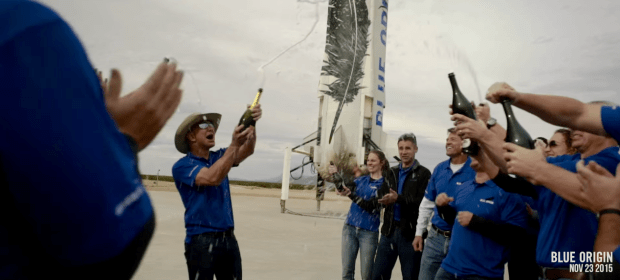
Bezos makes a couple of cameo appearances in the video – including a shot showing him taking a seat in the control room before launch, and a post-landing scene in which he pops open a champagne bottle. (He’s the guy wearing the hat and sunglasses.)
The achievement arguably qualifies New Shepard as the “first fully reusable rocket” to go into space, said Jessica Pieczonka, a spokeswoman for Blue Origin. The flight comes after more than a decade of effort and several test flights at Blue Origin’s launch facility near Van Horn, Texas. The company is headquartered in Kent, Wash., and recently struck a deal for a $200 million launch and manufacturing complex in Florida.
Blue Origin’s aim is to reduce the cost of sending people and payloads to the final frontier – first, on suborbital up-and-down trajectories, and eventually into orbit and back. The venture follows through on Bezos’ childhood dream of spaceflight.
“It’s really exciting to see SpaceX and Boeing with hardware in flow for their first crew rotation missions,” Kathy Lueders, manager of NASA’s Commercial Crew Program, said today in a news release. “It is important to have at least two healthy and robust capabilities from U.S. companies to deliver crew and critical scientific experiments from American soil to the space station throughout its lifespan.”
Even though the first order went to Boeing, it has not yet been determined whether Boeing’s CST-100 Starliner capsule or SpaceX’s Crew Dragon capsule will go first. The contracts required NASA to put in its orders early, but the scheduling decisions and required certifications will be made at a later time.
Blue Origin’s New Shepard prototype spaceship lifts off for a test flight in April. (Blue Origin photo)
Even as Jeff Bezos celebrates past achievements in spaceflight, he’s looking forward to seeing his Blue Origin space venture make future achievements.
The next flight test of Blue Origin’s New Shepard suborbital spaceship should come “very soon,” Bezos said Thursday at Seattle’s Museum of Flight, after a ceremony marking the arrival of historic Saturn V rocket engine parts that his Bezos Expeditions team recovered from the Atlantic two years ago.
“We’re ready and excited to fly again,” Bezos said.
A SpaceX Falcon 9 rocket launches the DSCOVR satellite in February. (Credit: SpaceX)
SpaceX is poised to win an Air Force national security launch contract by default because its archrival, United Launch Alliance, has dropped out of the competition.
ULA said this week that it decided not to bid on the Air Force contract for launching a GPS-3 satellite in 2018, leaving SpaceX as the sole bidder. The contract was the first of its kind to come up since the Air Force certified SpaceX’s Falcon 9 rocket to launch national security payloads.
Reuters quoted ULA’s chief executive officer, Tory Bruno, as saying that the Boeing-Lockheed Martin joint venture couldn’t submit a compliant bid because of a federally mandated ban on the use of Russian-built RD-180 engines for national security launches. ULA uses the RD-180s on the first stage of its Atlas 5 rocket, which has traditionally been used for such launches. A defense authorization bill currently under consideration in Congress includes a provision that would give ULA access to four more of the engines, but that bill has not yet been signed into law.
Bruno also told Reuters that the criteria for bid selection don’t give ULA enough credit for its record of reliability and schedule certainty, and that the accounting procedures for separating the funds for GPS-3 from other government contracts were too onerous.
Monday was the deadline for submitting a bid for the GPS-3 launch. SpaceX declined to comment on the prospects for the contract, which is thought to be worth in the neighborhood of $70 million to $80 million.
An artist’s conception shows the Stratolaunch jet landing. (Credit: Vulcan Aerospace)
The world’s largest airplane is taking shape for Microsoft co-founder Paul Allen’s Vulcan Aerospace venture, but it’s not yet clear what kind of rocket would be launched from the Stratolaunch super-jumbo jet.
The uncertainties reflect transitions taking place at Vulcan Aerospace as well as in the launch industry. Last month, the venture’s president, Chuck Beames, said he was still in the midst of defining where Stratolaunch fit in the context of Vulcan’s wider “NextSpace” vision. Meanwhile, there’s been a switch in the CEO spot for the Stratolaunch Systems subsidiary, from Gary Wentz to Jean Floyd.
The past few months also have been marked by rapid shifts in the satellite launch industry – particularly for small to medium-size satellites, which are supposed to be in the sweet spot for Stratolaunch’s air-launch system. The Wall Street Journal quotes unnamed aerospace industry officials as saying those shifts could threaten the project’s overall viability.
In a statement emailed to GeekWire, Vulcan Aerospace said the Journal’s report was “inaccurate” and “based on nothing more than rumors and speculation, not facts.” The statement went on to sketch out Vulcan’s vision of transforming space transportation to low Earth orbit by changing the current model for launching payloads into space.
Blue Origin’s prototype suborbital spaceship rises from its launch pad in April. (Blue Origin photo)
Blue Origin, the space venture backed by Amazon founder Jeff Bezos, is reportedly planning to start flying research payloads on its New Shepard suborbital space vehicle as early as the first half of 2016.
“We’re aiming for the second quarter of next year,” Space News quoted Erika Wagner, business development manager for Blue Origin, as saying on Tuesday at a workshop in Washington, D.C. The workshop on microgravity research was organized by NanoRacks, a Houston-based company that’s partnering with Blue Origin to fly scientific experiments on New Shepard.
Blue Origin, which is headquartered in Kent, Wash., has been putting New Shepard through a series of uncrewed flight tests at the company’s West Texas launch facility. The most recent test took place in April. The rocket-powered vehicle rose to a height of 307,000 feet – and although the propulsion module couldn’t be recovered as hoped, due to a hydraulic problem, the crew capsule made a flawless parachute landing.
“Any astronauts on board would have had a very nice journey into space and a smooth return,” Bezos said at the time.
Like the test flights, the research flights would be launched without a crew. Instead, standard-size payload lockers would be loaded aboard New Shepard, sent up on a flight rising above 100 kilometers (62 miles) that would involve about three minutes of weightlessness, and then be recovered after landing.
An artist’s conception shows Boeing’s CST-100 Starliner space taxi in orbit. (Credit: Boeing)
Boeing says it’s out of the running for NASA’s next contract to deliver cargo to the International Space Station, but it’ll still be sending up cargo as well as astronauts on its CST-100 Starliner spaceship under the terms of different deal.
The update came as NASA said that its selection of contractors for the second round of commercial resupply services for the space station, previously scheduled to be announced today, would have to wait.
“CRS2 is a complex procurement,” NASA said in an emailed statement. “The anticipated award date has been revised to no later than January 30, 2016, to allow time to complete a thorough proposal evaluation and selection. Since the agency is in the process of evaluating proposals, we are in a procurement communications blackout. For that reason, NASA cannot answer questions about this procurement at this time.”
The CRS2 contracts are likely to be worth billions of dollars, and would cover a period running from 2018 to 2024.
Jeff Bezos shows off the concept for Blue Origin’s launch system during a September news conference in Florida. Bezos’ Blue Origin space venture is headquartered in Kent, Wash. (Blue Origin photo)
What is it about Seattle that’s led some folks to call it the “Silicon Valley of space,”and how far can space entrepreneurs go in the next 20 years? One of the panels at Friday’s Xconomy Seattle 2035 conference tackled those questions – and added a couple of shorter-term predictions as well.
Jason Andrews, the CEO of Seattle-based Spaceflight Inc., listed three reasons why Seattle is up there with Southern California, Silicon Valley, Texas and Florida’s Space Coast when it comes to commercial spaceflight.
Former NASA Deputy Administrator Lori Garver chats with Alan Boyle during the GeekWire Summit.
If we want to send astronauts to Mars, we better find a way to do it within 10 years. And if we want to discover a blue planet around an alien sun, there’s a good chance it could happen within five years.
That’s how former NASA Deputy Administrator Lori Garver sized up the future of space travel and exploration at the GeekWire Summit on Thursday.
Today, Garver is general manager of the Air Line Pilots Association. But back in 2008, she helped set the space policy trajectory for the Obama administration, and then took the No. 2 spot at the space agency as Administrator Charles Bolden’s deputy. During her four years in that role, she played a key part in NASA’s shift from the space shuttle era to the commercial spaceflight era.
So what’s ahead? Find out what Garver had to say during Thursday’s fireside chat.