CenturyLink Field’s arches were lit up in blue to boost autism awareness in April. On Tuesday night, they’ll go blue again in honor of the Allen Institute’s 15-year celebration. (Seahawks Photo / Corky Trewin)
If you see a lot of blue lights around Seattle landmarks this week, it’s not in honor of the Seahawks — this time, the color scheme is paying tribute to another one of Microsoft co-founder Paul Allen’s pet projects, the Allen Institute.
Hot spots such as CenturyLink Field, home of the Seahawks; and Columbia Tower, Seattle’s tallest building, will be turning on their cool-blue mood lighting to celebrate the 15th anniversary of the institute’s founding in 2003.
Microsoft co-founder Paul Allen is known for his philanthropic contributions to causes such as the University of Washington – and now he’s in the spotlight for political contributions as well. (GeekWire Photo)
Microsoft co-founder Paul Allen has made his largest-ever contribution to congressional candidates in the form of a $100,000 donation to the Republicans’ “Protect the House” political action committee.
Allen’s contribution, which was made in June and came to light today in a Seattle Times report, could bring further attention to the role of tech leaders in the crucial midterm congressional campaign.
Artwork shows Stratolaunch’s giant carrier plane and several classes of launch vehicles, including Northrop Grumman’s Pegasus rocket, a medium-class rocket and its heavy-lift variant, and a fully reusable space plane. (Stratolaunch Illustration)
Stratolaunch, the space venture created by Microsoft co-founder Paul Allen in 2011, today provided the first details about a new family of launch vehicles it has in the works, including two types of rockets and a reusable space plane that could someday carry astronauts to orbit.
The revelation follows up on rumblings that Stratolaunch has been working on its own rockets and a “Black Ice” space plane, along with the world’s biggest airplane to launch them from.
An image captured by a remotely operated vehcile from the R/V Petrel shows the barrel of a 5-inch gun on the USS Lexington. (Image courtesy of Paul G. Allen. Copyright Navigea Ltd.)
It’s traditional to revisit the gravesites of America’s fallen warriors on Memorial Day, but billionaire philanthropist Paul Allen is adding a non-traditional twist.
Today the co-founder of Microsoft is highlighting the work that he’s funded over the past couple of years to document the wrecks of historic warships — and not only U.S. ships, but naval vessels that flew the flags of Japan, Italy and Australia.
A newly unveiled website celebrates the exploits of the Petrel, Allen’s research ship, and its remotely operated vehicle. But more importantly, it celebrates the sacrifices made by the crews of such venerable ships as the USS Indianapolis, the USS Lexington, the USS Juneau and the USS Helena.
Score another undersea revelation for the crew of the Petrel, a research vessel backed by Microsoft co-founder Paul Allen.
This time it’s the AE1, Australia’s first submarine and the first Allied submarine loss of World War I.
The AE1 was lost at sea with 35 officers and crew on board on Sept. 14, 1914, after it sailed away on patrol near the Duke of York Islands, east of Papua New Guinea in the Pacific Ocean.
For more than a century, the Royal Australian Navy had no idea what happened to the sub. Not a trace of it was found — until last December. That’s when an autonomous underwater vehicle operated by the Royal Australian Navy used side-scan sonar to detect the wreck on the seafloor, more than 300 meters (984 feet) beneath the surface.
The precise location wasn’t disclosed, to keep salvagers from interfering with what’s essentially an underwater gravesite. But the Australian search effort, coordinated by a company called Find AE1 Ltd., enlisted the Petrel and its remotely operated vehicle to capture high-resolution video and stills of the remains.
Stratolaunch’s twin-fuselage plane catches the sun’s rays during a test outing. (Stratolaunch Photo)
COLORADO SPRINGS, Colo. — Microsoft co-founder Paul Allen’s Stratolaunch space company says it’s on track to conduct the first test flight of its mammoth airplane this summer, and use it to send rockets into orbit as early as 2020.
The status check came today during a background briefing here at the 34th Space Symposium, conducted under background-only conditions that precluded quoting sources by name.
The “50” painted on the hull helped identify the shipwreck as the USS Helena, which was sunk during World War II. The inset image shows the ship’s sonar signature. (Paul G. Allen Photo)
Microsoft co-founder Paul Allen’s seagoing sleuths are reporting one more find in their quest to locate sunken military vessels from World War II.
This time it’s the USS Helena, a St. Louis-class light cruiser that was hit during the Japanese attack on Pearl Harbor in 1941 but went on to meritorious service in three Pacific naval battles. Its service was so meritorious that the Helena became the first U.S. ship to receive a Navy Unit Commendation.
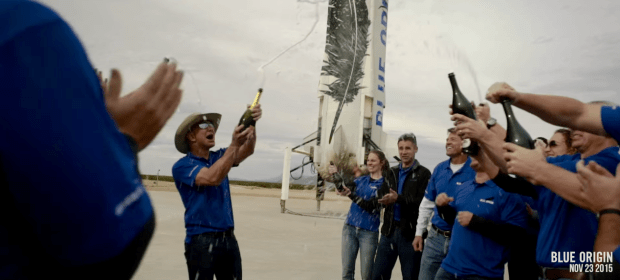
Jeff Bezos, the founder of Amazon and Blue Origin, sprays champagne from a bottle after a successful rocket landing in November 2015. (Credit: Blue Origin via YouTube)
Space is hard: That used to be the excuse for explaining why sending people into space would always be something only governments could do. Now it explains why even billionaires find the feat difficult.
To persevere, even billionaires have to have a passion for spaceflight, most likely fostered at an early age, and an iron resolve to weather adversity. That comes through loud and clear in two newly published books, plus a TV documentary that’s premiering tonight.
Pierre Dutrieux, an oceanographer from Columbia University’s Lamont-Doherty Earth Observatory, works on one of the three Seaglider underwater drones deployed in West Antarctica. (Paul G. Allen Philanthropies Photo)
A scientific team supported by Microsoft co-founder Paul Allen is reporting the successful deployment of a trio of undersea drones to monitor how climate change affects Antarctica’s ice sheets.
Now it’s up to the drones.
“We are so pleased with both the initial data collection and the unprecedented operational success of the mission thus far,” Spencer Reeder, director of climate and energy for Paul G. Allen Philanthropies, said in a news release. “It is hard to fathom that we have already witnessed multiple fully autonomous Seaglider forays of up to 140 kilometers round-trip under the ice shelf.”
The project is being conducted by researchers from the University of Washington and Columbia University’s Lamont-Doherty Earth Observatory, with almost $2 million in funding from Allen.
The propeller of the USS Juneau rests on the South Pacific seafloor. (Navigea via PaulAllen.com)
The latest chapter of an Irish-American family tragedy played out on St. Patrick’s Day when an expedition team backed by Microsoft co-founder Paul Allen discovered the shipwreck of the USS Juneau in the South Pacific.
The Juneau was sunk by a Japanese torpedo during the Battle of Guadalcanal on Nov. 13, 1942, leading to the deaths of 687 sailors — including the five Sullivan Brothers.
The Sullivans insisted so forcefully on serving together that naval officers bent their rules against having brothers serving on the same ship during wartime.
The Iowa family’s tragic story rallied the nation during World War II, inspired a movie titled “The Fighting Sullivans” and led to the christening of two Navy ships in honor of the Sullivans.